Economists Split Over Tinubu’s ₦58.47 Trillion 2026 Budget as Strengths, Risks Emerge
A mix of cautious optimism and deep concern has greeted President Bola Ahmed Tinubu’s proposed ₦58.47 trillion 2026 Appropriation Bill, as economic analysts dissect both its promise and its potential pitfalls.
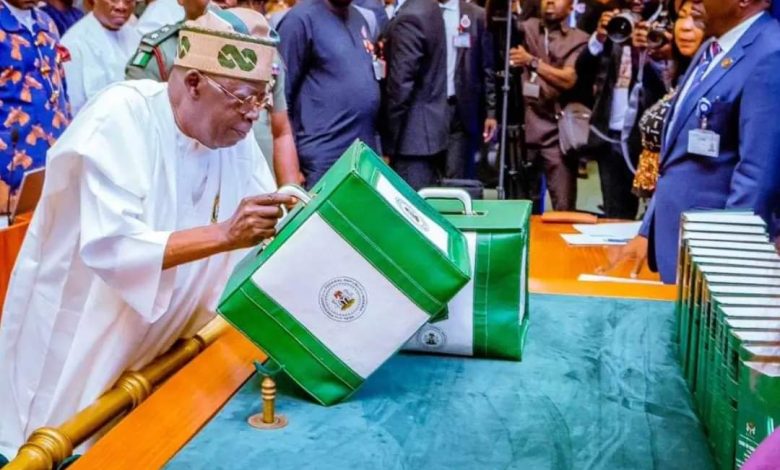
Details of the proposal presented to a joint sitting of the National Assembly on Friday, obtained by PulseNets, show that Security and Defence tops sectoral allocations with ₦5.41 trillion, followed by Infrastructure at ₦3.56 trillion, Education with ₦3.52 trillion, and Health at ₦2.48 trillion.
The 2026 budget framework is built around ₦34.33 trillion in projected revenue, ₦58.18 trillion in total expenditure, and ₦15.52 trillion earmarked for debt servicing, figures that once again highlight Nigeria’s mounting fiscal pressures.
PulseNets learnt that the proposal rests on key macroeconomic assumptions, including an oil price benchmark of $64.85 per barrel, daily oil production of 1.84 million barrels, and an exchange rate of ₦1,400 to the dollar. In nominal terms, the 2026 budget represents a sharp increase over the ₦43.56 trillion (2024) and ₦54.99 trillion (2025) fiscal plans.
In separate conversations spoke to PulseNets, the Chief Executive Officer of the Centre for the Promotion of Private Enterprise (CPPE), Dr. Muda Yusuf, and the CEO of SD & D Capital Management, Gbolade Idakolo, offered contrasting but complementary assessments of the proposal.
Yusuf: Better structured, but still optimistic
Dr. Yusuf described the 2026 budget as structurally superior to the 2024 and 2025 versions, noting that its underlying assumptions appear more restrained and pragmatic.
However, he warned that both the oil price benchmark and production targets may still be overly optimistic when measured against Nigeria’s historical output and recurring disruptions in the oil sector.
“The 2026 budget is clearly better structured than what we have seen in recent years. The assumptions are more conservative than those of 2025, but there is still room for improvement,” Yusuf told PulseNets.
He argued that pegging oil at nearly $65 per barrel leaves little buffer for volatility, suggesting a more cautious benchmark to strengthen credibility.
“An oil price closer to $60 per barrel would inspire more confidence. Also, projecting production at around 1.8 million barrels daily does not fully reflect our historical performance. These assumptions can be further refined to improve realism,” he said.
Yusuf also cautioned the National Assembly against inflating the budget through constituency insertions, a practice he said has historically weakened implementation and eroded public trust.
“The value of a budget is not in its size but in its credibility. Once lawmakers begin arbitrary upward revisions, especially through constituency projects, we set ourselves up for poor execution and disappointment,” he stressed.
According to him, repeated failures to fully implement budgets risk undermining confidence in fiscal policy itself.
Beyond expenditure concerns, Yusuf identified non-tax revenue leakages from government-owned enterprises as a persistent weakness that must be addressed.
“One major shortfall year after year is revenue from government agencies. Optimising non-tax revenue remains critical, and this aligns with the President’s emphasis on fiscal consolidation,” he noted.
While acknowledging the administration’s push toward fiscal discipline, Yusuf expressed serious concern over the debt servicing burden, which he said now absorbs nearly half of projected revenue.
“Debt service at almost 50 percent of revenue is not sustainable. It shrinks fiscal space and directly affects capital budget implementation. This underscores the urgent need to rethink our debt management strategy,” he warned.
He further raised questions about how the new 2026 proposal would coexist with the recently reenacted 2025 Appropriation Act, cautioning against overlapping budget regimes.
“We need clarity on how the 2026 budget will be reconciled with the re-enacted 2025 budget. Multiple budget cycles running simultaneously only complicate implementation and expectations,” Yusuf said.
On execution, he noted that while recurrent expenditure is often largely implemented, capital budget performance remains weak, limiting productivity gains and economic impact.
Yusuf also broadened the accountability conversation beyond Abuja, insisting that state and local governments must be equally scrutinised.
“Budget discussions in Nigeria are too federal-centric. States and local governments now control significantly larger resources. Many states are operating near or above the ₦1 trillion mark, and these funds must translate into tangible outcomes in health, education, infrastructure, agriculture, and rural development,” he said.
“They must be held just as accountable as the federal government,” he added.
Idakolo: Bold framework with growth potential
On his part, Gbolade Idakolo described the ₦58.46 trillion proposal as a bold fiscal statement, aimed at consolidating recent reforms, even as a substantial portion of capital spending is expected to roll into 2026.
“The 2026 budget represents a deliberate effort by the Federal Government to build on gains from the last fiscal cycle, despite the reality that over 70 percent of capital expenditure may spill into 2026,” Idakolo told PulseNets.
He commended the heavy allocation to defence and security, arguing that stabilising the security environment is fundamental to restoring investor confidence and long-term growth.
“Security is central to investment and economic prosperity. The scale of insecurity we currently face is a major drag on growth. Prioritising defence spending and ensuring full implementation can help steady the economy,” he stated.
Idakolo also welcomed the strong focus on infrastructure, education, and health, describing them as critical enablers of productivity and human capital development.
“Infrastructure drives development and job creation. Education and health strengthen our most valuable asset — human capital. The emphasis on these sectors is well placed,” he said.
According to him, the budget could stabilise and expand the economy if funds are released promptly and projects are executed efficiently.
“If implementation matches intent, the 2026 budget can significantly support economic stability and growth,” Idakolo noted.
Also Read: Tinubu to Present 2026 Budget Without Accounting for 2025 Fiscal Year Performance — BudgIT
However, he urged lawmakers to rigorously interrogate the assumptions and allocations to avoid a repeat of past implementation gaps.
“The National Assembly must subject all projections and allocations to critical scrutiny to ensure realism within the budgetary framework,” he advised.