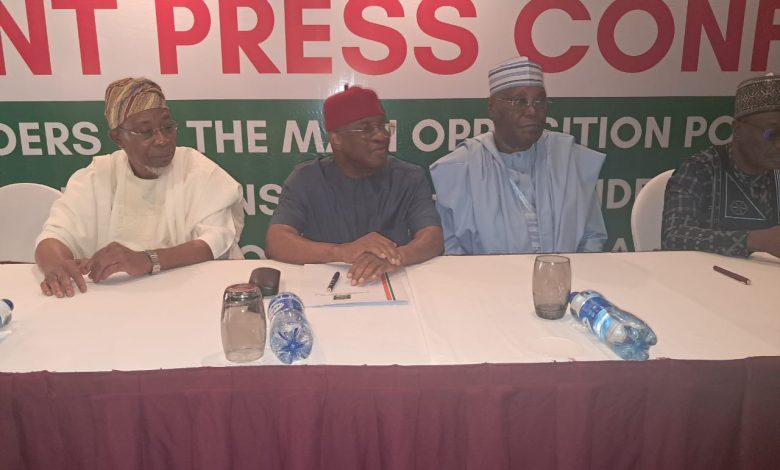
Atiku, Obi, Amaechi Lead Emergency Opposition Meeting Over Electoral Act 2026
Senior opposition figures on Thursday converged on Abuja to publicly repudiate the newly amended Electoral Act 2026, escalating political tensions ahead of the 2027 general elections and setting the stage for a fierce legislative and legal battle.
The high level joint press conference, held at the Transcorp Hilton Hotel in the Federal Capital Territory on February 26, 2026, brought together former Vice President Atiku Abubakar, former Labour Party presidential candidate Peter Obi, former Rivers State Governor Rotimi Amaechi, ADC National Chairman and former Senate President David Mark, ADC National Secretary Rauf Aregbesola, NNPP stalwart Buba Galadima, and other prominent opposition leaders.
The gathering, themed “Urgent Call to Save Nigeria’s Democracy,” focused squarely on the Electoral Act 2026 recently passed by the National Assembly and assented to by President Bola Tinubu. The coalition described the amended law in stark terms, branding it “anti-democratic,” “obnoxious,” “desperate,” and “dictatorial.” They accused the ruling All Progressives Congress of engineering legal frameworks capable of distorting electoral transparency ahead of the 2027 elections.
Fresh Amendments Demanded
PulseNets learned that the opposition bloc is demanding an immediate new amendment process by the National Assembly to expunge what they called “obnoxious provisions” and realign the Act with the constitutional principles of free, fair, transparent, and credible elections.
Central to their objections is Section 60(3) of the Act. The leaders argue that the clause permits the Independent National Electoral Commission to revert to manual collation of results in the event of “network failure,” a move they insist could undermine electronic transmission protocols. They contend that with Nigeria’s estimated 90 to 95 percent 2G and internet penetration, real time electronic transmission of results to the IReV portal should remain mandatory, not optional.
Section 84(2) also drew sharp criticism. The coalition described it as an encroachment on the internal mechanisms of political parties by mandating either Direct or Consensus primaries, which they view as federal interference in party affairs.
Beyond specific clauses, broader concerns were raised about what the leaders characterised as a creeping authoritarian pattern in governance. In video excerpts circulating after the conference, Peter Obi described the current administration as “the worst Nigeria has ever seen,” linking the electoral amendments to worsening economic hardship, insecurity, and governance failures.
Joint Communiqué and Coalition Strategy
PulseNets obtained details of a joint communiqué read by NNPP National Chairman Ajuji Ahmed and endorsed by Atiku Abubakar, Peter Obi, Rotimi Amaechi, David Mark, and other signatories.
Atiku, speaking at the event, stressed the urgency of opposition unity, insisting that defending democratic norms must transcend party lines. He warned against what he termed perceived plans to manipulate the 2027 electoral process and called for coordinated resistance.
The emerging coalition, which PulseNets learnt is gravitating toward the African Democratic Congress as a potential unifying platform, also disclosed plans to formally communicate its position to diplomatic missions. The bloc appealed to civil society organisations, professional bodies, and the international community to closely monitor developments surrounding Nigeria’s 2027 elections.
APC, Presidency, and Senate React
The All Progressives Congress swiftly rejected the opposition’s allegations. APC National Publicity Secretary Felix Morka dismissed the protest as exaggerated and politically motivated.
Presidential Adviser Bayo Onanuga, in remarks reported by PulseNets, accused opposition figures of making inflammatory statements aimed at misleading Nigerians and courting media attention.
The Senate equally pushed back against calls for fresh amendments. Lawmakers advised aggrieved stakeholders to pursue their concerns through established legislative processes rather than public pressure campaigns.
INEC Timetable Adjustment
Amid the controversy, the Independent National Electoral Commission has moved to align its timetable with the new Electoral Act 2026. PulseNets learned that the Commission revised statutory timelines in compliance with the amended law and reportedly fixed January 16, 2027, for the presidential election.
Also Read: Minna Political Talks: Fayose Reveals Atiku–Makinde ADC Deal, Alleges Obi Sidelined Ahead of 2027
Opposition leaders argue that the adjustments consolidate structural advantages for the ruling party. However, INEC officials maintain that the Commission is bound by law to operate within the framework enacted by the National Assembly and signed by the President.
With political alliances shifting and rhetoric intensifying, the dispute over the Electoral Act 2026 is fast becoming a defining fault line ahead of Nigeria’s 2027 general elections.