2027 Elections: Centre LSD Raises Concerns Over INEC, Voters’ Register, Calls for Electoral Reforms
The African Centre for Leadership, Strategy & Development (Centre LSD) has raised concerns over Nigeria’s preparedness for the 2027 General Elections, calling on the Independent National Electoral Commission (INEC), political parties, security agencies and other stakeholders to take urgent steps to safeguard electoral credibility and restore public confidence.
Centre LSD, alongside ActionAid Nigeria, Abuja School and Political Thoughts, and MOTION and Partners, made the call in a press statement issued in Abuja on Wednesday, November 4, 2026, warning that credible elections must be guaranteed through concrete actions throughout the electoral cycle rather than relying on assurances from INEC.
The organisations expressed concern over unresolved issues surrounding electronic transmission of election results, the integrity of the National Register of Voters, public confidence in INEC, political party conduct, campaign financing, insecurity, electoral violence and the growing use of digital platforms to manipulate public opinion.
According to the statement, the Presidential and National Assembly elections are scheduled for January 16, 2027, while the Governorship and State Houses of Assembly elections will hold on February 6, 2027.
The organisations warned that the credibility of the forthcoming elections would have far-reaching consequences for democratic legitimacy, national cohesion, political stability, public confidence in government and Nigeria’s democratic development.
They maintained that lessons from previous electoral cycles, particularly the 2023 General Elections, must inform the preparations for 2027.
“Our position is that the credibility of the 2027 elections must not be left to chance, political assurances or last-minute interventions. It must be deliberately secured through institutional accountability, transparent processes, enforceable rules and active citizen participation,” the statement read.
Centre LSD Tasks INEC on Transparency and Accountability
The organisation acknowledged INEC’s constitutional responsibility for conducting elections and its ongoing preparations but insisted that the Commission must demonstrate transparency, consistency, impartiality and accountability to regain public trust.
It noted that controversies surrounding the 2023 General Elections continued to influence public perceptions of the electoral body, describing the 2027 elections as an opportunity for INEC to demonstrate that lessons from the previous exercise had translated into institutional and operational improvements.
Centre LSD called on INEC to publish regular and comprehensive updates on its preparedness, covering logistics, personnel, technology, procurement and funding.
It also urged the Commission to disclose clear operational guidelines for voter accreditation, voting, electronic transmission, collation and declaration of results.
Other recommendations include strengthening stakeholder engagement, establishing effective channels for addressing public complaints, conducting independent technical audits of electoral technologies and ensuring that electoral personnel are adequately trained and protected from political intimidation.
The organisation stressed that public confidence must be earned through verifiable institutional conduct rather than demanded through official assurances.
Electronic Transmission of Results: Centre LSD Cites Electoral Act 2026
The statement identified electronic transmission of election results as one of the major issues requiring clarity ahead of the 2027 General Elections.
According to Centre LSD, the failure to meet public expectations regarding real-time electronic transmission and public viewing of polling-unit results was among the most significant controversies arising from the 2023 elections.
It argued that technology should strengthen electoral transparency and reduce opportunities for manipulation during the collation process.
The organisation therefore called on INEC to provide an unambiguous explanation of the entire result management process in line with Section 60(3) of the Electoral Act 2026.
The provision states:
“The Presiding Officer shall electronically transmit the results from each polling unit to IREV portal and such transmission shall be done after the prescribed Form EC8A has been signed and stamped by the Presiding officer and/or countersigned by the candidates or Polling agents where available at the Polling Unit: Provided that in all cases, the Form EC8A shall remain the primary source of collation and declaration of the result.”
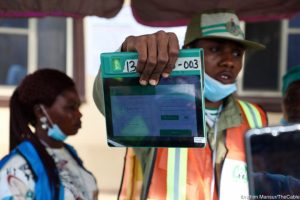
Centre LSD further urged INEC to explain the relationship between BVAS accreditation, polling-unit result documentation, electronic transmission, IReV publication and subsequent collation.
It also recommended nationwide simulations of the Commission’s electoral technology before the elections, with the participation of political parties, civil society organisations, technical experts and the media.
The organisation maintained that every polling-unit result must be traceable, verifiable and accessible to the public to prevent avoidable ambiguity and discretionary manipulation.
Centre LSD Questions Integrity of National Voters’ Register
Another major concern raised by the organisation relates to the integrity of the preliminary National Register of Voters, particularly reports of suspicious photographs and possible irregularities in some voter records.
The statement identified active voter registration records allegedly belonging to several deceased prominent Nigerians, including former President Muhammadu Buhari, former Ondo State Governor Rotimi Akeredolu, former Senator representing Anambra South, Ifeanyi Ubah, and media founder Raymond Dokpesi.
It noted that the individuals died in July 2025, December 2023, July 2024 and May 2023, respectively.
The organisation argued that the continued appearance of such records raised broader questions about the accuracy of the voters’ register.
It further stated that only about 10 per cent of deaths in Nigeria are formally registered, while INEC had reportedly removed just 7,746 deceased registrants.
Using United Nations and World Bank mortality data alongside INEC’s registration figures, the organisation estimated that between 12 million and 18 million of the 103.4 million registered voters could be deceased.
This represents approximately one in every seven names on the register, according to its assessment.
Centre LSD warned that an inaccurate voters’ register could have several consequences, including distorting voter turnout figures, creating opportunities for electoral manipulation in low-turnout areas, concealing irregularities and increasing expenditure on electoral materials and logistics.
The statement also noted that INEC’s planned revalidation exercise had been postponed until after the 2027 elections.
While acknowledging that the Commission had indicated it was examining the concerns and undertaking corrective measures where necessary, Centre LSD insisted that the integrity of the voters’ register should not be treated as an ordinary administrative matter.
It called for a transparent audit of the register, investigation of complaints involving duplicate, fictitious, deceased or otherwise ineligible voters, and an accessible process for citizens and political stakeholders to submit claims and objections.
The organisation also urged INEC to publish information on its biometric verification and data-cleaning procedures while protecting citizens’ personal information.
It encouraged Nigerians to participate in the ongoing claims and objections process rather than leave the responsibility entirely to INEC and political parties.
Women, Youth and Persons with Disabilities Must Be Included
Centre LSD also called for greater political inclusion, warning that the continued underrepresentation of women, young people and persons with disabilities in political leadership and decision-making remained a serious democratic concern.
It maintained that democratic participation should extend beyond voter registration and voting to include opportunities to contest elections, participate in political party structures, influence public policy and contribute to governance.
The organisation urged political parties to eliminate discriminatory barriers, reduce nomination costs, promote affirmative action and create opportunities for women and young people to emerge as candidates.
It also called on INEC to improve voting accessibility through appropriate assistive materials, accessible polling environments and voter education tailored to persons with disabilities.
The National Assembly and other relevant stakeholders were equally urged to revisit the proposed constitutional reserved seats framework for women and other legislative measures aimed at improving political representation.
Centre LSD Launches Electoral Credibility Analysis Centre
As part of its response to the identified challenges, Centre LSD announced that it was strengthening its electoral integrity interventions through its “All Eyes on Electoral Credibility” initiative.
The organisation disclosed that it had activated an Electoral Credibility Analysis Centre to coordinate its election-related programmes and assess electoral preparedness and integrity before, during and after the elections.
According to the statement, the centre will produce monthly Electoral Credibility Reports to inform public discussions, identify emerging concerns and support timely interventions by relevant stakeholders.
The initiative will operate through Centre LSD’s Election Credibility Index, also known as the THRIVE Index, which assesses electoral credibility across six key areas.
These include Transparency, Healthy Environment, Reforms, Inclusivity, Voter and Political Education, and Equipment Functionality.
The organisation explained that the framework would assess openness and accountability in electoral processes, peaceful electoral conditions, the adequacy of electoral laws, inclusion of marginalised groups, citizens’ political awareness and the reliability of electoral technology and logistics.
It added that its planned interventions would include periodic electoral credibility assessments, citizen-led monitoring, voter and political education, early warning systems for election violence, monitoring of political party primaries and campaign financing, and advocacy for electoral accountability.
Centre LSD also disclosed plans to work with relevant partners to strengthen citizens’ capacity to independently document and verify polling-unit results and report electoral violations through lawful channels.
Centre LSD Issues Demands to INEC, Political Parties, Security Agencies
In its call to action, the organisation outlined specific responsibilities for key institutions and stakeholders ahead of the 2027 elections.
It urged INEC to demonstrate impartiality, transparency and operational preparedness while restoring public confidence through verifiable processes and timely disclosure of electoral information.
The National Assembly was asked to strengthen the legal and institutional framework for credible elections, address outstanding electoral reform issues and support effective enforcement of electoral laws.
Political parties and candidates were urged to respect internal democracy, conduct responsible campaigns, reject violence and vote buying, deploy accredited party agents to all polling units and commit to accepting credible electoral outcomes.
Centre LSD also called on security agencies to remain politically neutral, protect citizens and electoral personnel, and ensure that security arrangements serve the democratic process rather than partisan interests.
The judiciary was urged to uphold the rule of law, ensure timely and impartial resolution of electoral disputes and strengthen public confidence in electoral justice.
Similarly, civil society organisations were encouraged to coordinate their interventions, strengthen evidence-based monitoring and hold relevant institutions accountable.
The organisation also tasked the media with promoting responsible journalism, fact-checking political claims and resisting misinformation, hate speech and inflammatory narratives.
Development partners were urged to sustain their support for electoral integrity, institutional accountability, citizen participation and democratic resilience.
Nigerians, meanwhile, were encouraged to register, participate in the electoral process, vote peacefully, reject vote selling and remain vigilant in protecting their democratic rights.
Our Votes Must Count, Centre LSD Declares
Concluding the statement, Centre LSD described the 2027 General Elections as an opportunity to strengthen Nigeria’s democratic institutions and rebuild citizens’ confidence in the electoral process.
It warned that the country could not afford another electoral cycle dominated by controversies over transparency, technology, security, political manipulation and institutional accountability.
The organisation maintained that credible elections were achievable if institutions discharged their responsibilities transparently, political actors respected democratic rules, security agencies remained professional and citizens actively defended their democratic rights.
Also Read: INEC Faces Backlash Over Alleged AI-Generated Voter Images in Edo Ahead of 2027 Elections
It called on all stakeholders to treat electoral credibility as a national responsibility requiring urgent action, sustained commitment and measurable accountability.
“The credibility of the 2027 elections must be secured before, during and after election day.
“Our votes must count. Our mandates must be protected. Our democracy must be strengthened.
“ALL EYES ON ELECTORAL CREDIBILITY!” the statement concluded.
The press statement was signed by the Management of the African Centre for Leadership, Strategy & Development (Centre LSD).