New Service Chiefs Take Charge as Nigerians Demand Bold Security Reforms
Expectations across the country remain intense as Nigeria’s newly appointed Service Chiefs assume full command of the nation’s security architecture at a time of deepening unrest.
Amid escalating attacks by Boko Haram elements, bandits, kidnappers, and other violent non-state actors, Nigerians are hoping the fresh military leadership will initiate a complete overhaul of both tactical and operational responses nationwide. President Bola Tinubu had announced the shake-up last week, a development PulseNets learnt coincided with U.S. President Donald Trump’s controversial threat of possible military intervention over alleged attacks on Christians in Nigeria.
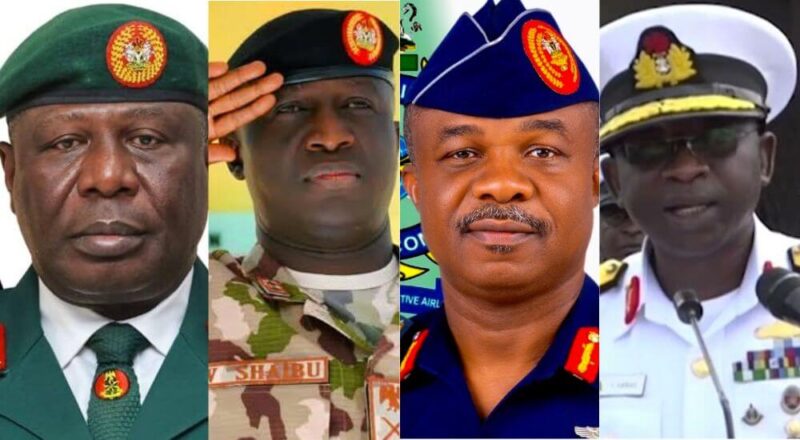
PulseNets obtained confirmation that former Chief of Army Staff, Olufemi Oluyede, now serves as Chief of Defence Staff, succeeding Christopher Musa. W. Shaibu has taken charge as Chief of Army Staff, SK Aneke now heads the Air Force, while I. Abbas becomes the new Naval Chief. E.A.P. Undiendeye retains his role as Chief of Defence Intelligence.
Stakeholders across defence, civil society, and human rights institutions have expressed cautious optimism, noting that the new team must work closely with the Presidency and security agencies to restore confidence in Nigeria’s security framework.
The Pan African United Development Network (PAUDEN) described the appointments as a strategic reset aimed at strengthening national defence capacity and re-entrenching professionalism within the Armed Forces. According to the group, the new leadership “is expected to accelerate Nigeria’s core security objectives and reinforce long-term stability.”
Similarly, the International Human Rights Commission, IHRC, reported rising curiosity in Northern communities, where residents are monitoring whether the replacements will promote fairness and balanced representation. IHRC’s Country Director, Captain Abdullahi Adamu (rtd), told PulseNets that the President’s move carries both political weight and strategic undertones.
In his words, “The decision signals readiness for tough reforms, but it also invites deeper questions about political calculations and internal power dynamics.”
He added that while the dismissals might be tied to the push for better performance, they also reflect urgent national concerns over insecurity.
Security analyst Bulama Bukarti also supported the shake-up, saying the President acted at the right time. According to him,
“If you look back at Nigeria’s security landscape in the last two years, you’ll see very clearly that leadership change was overdue.”
Bukarti noted that despite progress in degrading Boko Haram under both Tinubu and former President Muhammadu Buhari, the insurgency still poses significant threats in the Northeast.
Reactions also emerged from retired military leaders, who offered differing interpretations of the reshuffle. Some welcomed it as a long-awaited correction following years of extended tenures under previous administrations, while others argued that such changes are expected whenever fresh strategies are needed.
Former Peacekeeping Operations Director and ex-Commander of Operation Safe Haven, Major General Anthony Atolagbe (rtd), spoke to PulseNets, noting that the redeployment would likely boost morale within the military.
He explained, “This alignment is necessary. It keeps officers’ careers on track and reflects the conditions of service, where two-year tenures are standard unless extended by presidential discretion.”
Retired Rear Admiral Dickson Olisemelogor added that the restructuring was timely but stressed the need for operational autonomy.
According to him, “The new Chiefs are seasoned field officers with deep experience in internal security. What matters is giving them the freedom to act without interference.”
Executive Director of RULAAC, Okechukwu Nwanguma, highlighted that while leadership changes fall squarely within the President’s constitutional authority, their real impact depends on the integrity and strategic depth the new Chiefs bring to ongoing operations.
“Beyond the symbolism, Nigerians want innovation, transparency, and accountability in the fight against insecurity,” he stated.
Presidential aide Bayo Onanuga also clarified that the changes were driven by concerns over the handling of security matters.
He said, “This is a routine adjustment. The President wants renewed energy and better results.”
During the decoration ceremony, President Tinubu charged the new Chiefs to deliver without excuses.
“You are the commanders of our national defence. Nigerians demand results—not explanations,” he said.
Brigadier-General Sani Usman (rtd), a former Army spokesperson, told PulseNets that the new security heads deserve the benefit of doubt.
He noted, “Their screening showed clarity, firmness, and an understanding of the terrain. Their success, however, will depend on funding, direction, and continuity.”
Also Read: Alleged Coup — President Tinubu Sacks Service Chiefs, Appoints New Heads For Armed Forces
Security expert Mike Ejiofor echoed that the President has full authority to hire or replace Service Chiefs, adding that the previous team had served for two years.
Ejiofor added, “The outgoing leaders made strong contributions, especially former CDS Christopher Musa, who stabilised coordination across security agencies. The new Chiefs must now build on that momentum.”