Akpabio Backs Anioma State Creation as Asaba Proposed Capital, Warri for Delta
Senate President Godswill Akpabio has openly backed the proposed creation of Anioma State, injecting renewed political momentum into the long-standing agitation across Delta North.
PulseNets learnt that the proposal, which has lingered before the National Assembly for years, is currently being championed by Ned Nwoko.
The initiative is designed to expand state representation within the South-East geopolitical zone through the carving out of a new state from Delta State.
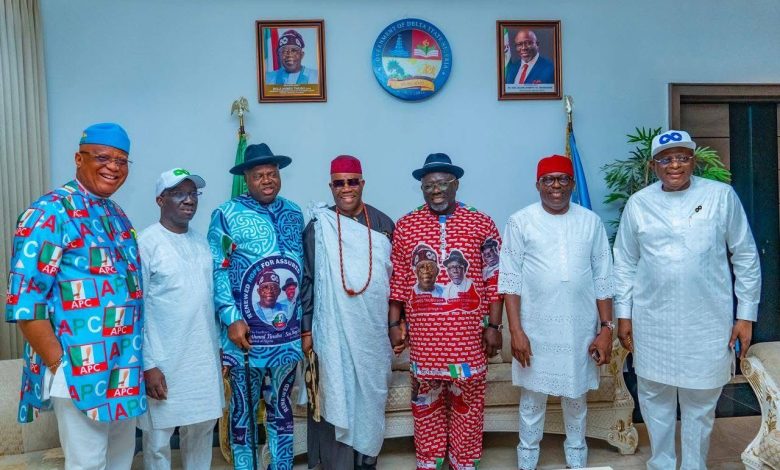
Akpabio, PulseNets reported, made his position known on Wednesday in Asaba during the All Progressives Congress South-South Zonal Congress.
Speaking to party faithful and stakeholders, he stated unequivocally that he finds nothing objectionable in the demand for the creation of a new state from the region.
He further explained the structural arrangement that would follow if the proposal secures approval. According to him, Asaba is expected to emerge as the capital of the proposed Anioma State, while Delta State would shift its capital to Warri.
The Senate President, PulseNets learnt, maintained that Nigerians should not view the proposal with apprehension, stressing that the multiplication of states would naturally drive broader development and economic expansion across regions.
He said, “If that is the only demand from the South-South for state creation, then I should be proud to support it.
“For Anioma State, the capital will be in Asaba; then the capital of Delta State proper will be in Warri. That’s not a problem.
“I don’t think we should be afraid because the more states we have, the more development. Assuming it passes through the various Houses of Assembly, it means we are going to have one additional state.
Also Read: Natasha Akpoti-Uduaghan Accuses Akpabio, Yahaya Bello of Power Abuse as Court Strikes Out Charges
“It is definitely going to be another broom and progressives from the South-Eastern part of Nigeria.”
The process for creating new states in Nigeria remains constitutionally demanding, requiring approval by the National Assembly, endorsement by a majority of State Houses of Assembly, and eventual presidential assent.