Abdulsalami Reveal Reasons He Advised Obasanjo Not to Contest 1999 Presidential Election After Prison Release
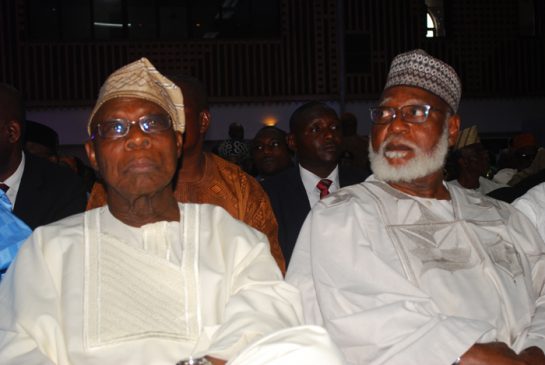
Former Head of State, Gen. Abdulsalami Abubakar (retd.), has disclosed that he personally advised former President Olusegun Obasanjo against contesting Nigeria’s 1999 presidential election shortly after his release from prison.
The retired military leader said his advice was informed by the ordeals Obasanjo experienced during the regime of the late Gen. Sani Abacha, noting that he believed the former Head of State should focus on rebuilding his life rather than returning to active politics.
The revelation is contained in Abdulsalami’s autobiography, Call of Duty, which was unveiled in Abuja as part of activities commemorating his 84th birthday.
PulseNets learnt that the memoir provides fresh insights into Nigeria’s transition from military rule to democracy and the political developments that paved the way for the Fourth Republic.
According to Abdulsalami, shortly after Obasanjo regained his freedom in 1998, he visited him to discuss two pressing matters. The first concerned his intention to sue the Federal Government over his detention, while the second related to mounting pressure from the Peoples Democratic Party (PDP) urging him to join the presidential race.
The former Head of State revealed that he discouraged Obasanjo from pursuing legal action, warning that court proceedings could drag on for years without a definite outcome.
“I was forthright with him. One, I advised him that he should not take the government to court because it might not augur well.
“For one, he would not know how long it would take the court to give judgment. I told him that, as a government, we would try to see what could be done about his business in the form of compensation.
“The court process was uncertain, I told him. I tried to dissuade him from pursuing the litigation option, and he agreed with me.”
Abdulsalami further disclosed that he was equally candid regarding Obasanjo’s possible presidential ambition.
“On the invitation by the PDP that he should run in the presidential race, I advised him to return home and thank God that he was still alive after all he had gone through in four years. I told him point-blank that he should forget about contesting to be President.
“He took a deep sigh and said he was going to think about it and revert. He never got back to me. He can confirm this encounter.”
Despite Obasanjo’s eventual emergence as Nigeria’s President in 1999, Abdulsalami maintained that his administration neither endorsed nor sponsored his candidacy.
The retired General dismissed long-standing claims that the military government deliberately cleared the path for Obasanjo’s victory, insisting that no such support was provided.
He explained that his administration simply implemented a broad policy of releasing political detainees and granting pardons without favouring any individual.
“I tell people till today that my administration had nothing to do with the presidential ambition of General Obasanjo.
“It may be hard to believe, but we did not endorse him, and we did not work for him. It was a conjecture.”
PulseNets learnt that Abdulsalami also noted that numerous political prisoners were released during the transition period, stressing that Obasanjo’s case attracted greater public attention largely because he later became President.
The former military ruler acknowledged reports that some retired military officers and influential Nigerians worked privately to persuade Obasanjo to contest the election. However, he emphasized that such efforts were personal initiatives and not part of government policy.
The autobiography also offers details on the political considerations that shaped Nigeria’s return to civilian rule.
According to Abdulsalami, his administration adjusted political party registration guidelines to ensure that the Alliance for Democracy (AD) was not excluded from the democratic process.
He explained that the move was necessary to prevent the South-West from feeling marginalized during a delicate period in the nation’s history.
“We had to apply some wisdom and flexibility. As projected, the AD eventually didn’t meet the criteria for the registration of political parties. We tinkered with the rules and said any party that came third would be registered. That was how AD scaled through.”
He said the decision was aimed at promoting fairness, national cohesion and political stability as Nigeria prepared to end years of military rule.
Abdulsalami also explained why the transition to civilian government eventually occurred in May 1999 instead of October 1998.
According to him, the judiciary requested adequate time to resolve election-related disputes before the inauguration of a new administration.
The former Head of State added that he resisted pressure from some military colleagues, foreign leaders and even members of the pro-democracy movement who advocated an extension of the transition timetable.
Also Read: Niger: What junta told us about Bazoum’s fate, message for ECOWAS — Abdulsalami reveals
He insisted that remaining in office beyond the planned period was never an option because Nigeria was under immense pressure and military rule had become unsustainable.
“For me, I was not in any way tempted to stay longer in office. I had made up my mind. By the time I took over the reins of power, the country was on the edge.
“Nigeria was at a breaking point. The military needed to relinquish power.”
Nevertheless, Abdulsalami said he remains satisfied with the decision to hand over power, expressing confidence that his administration played a significant role in restoring stability and democratic governance in Nigeria.