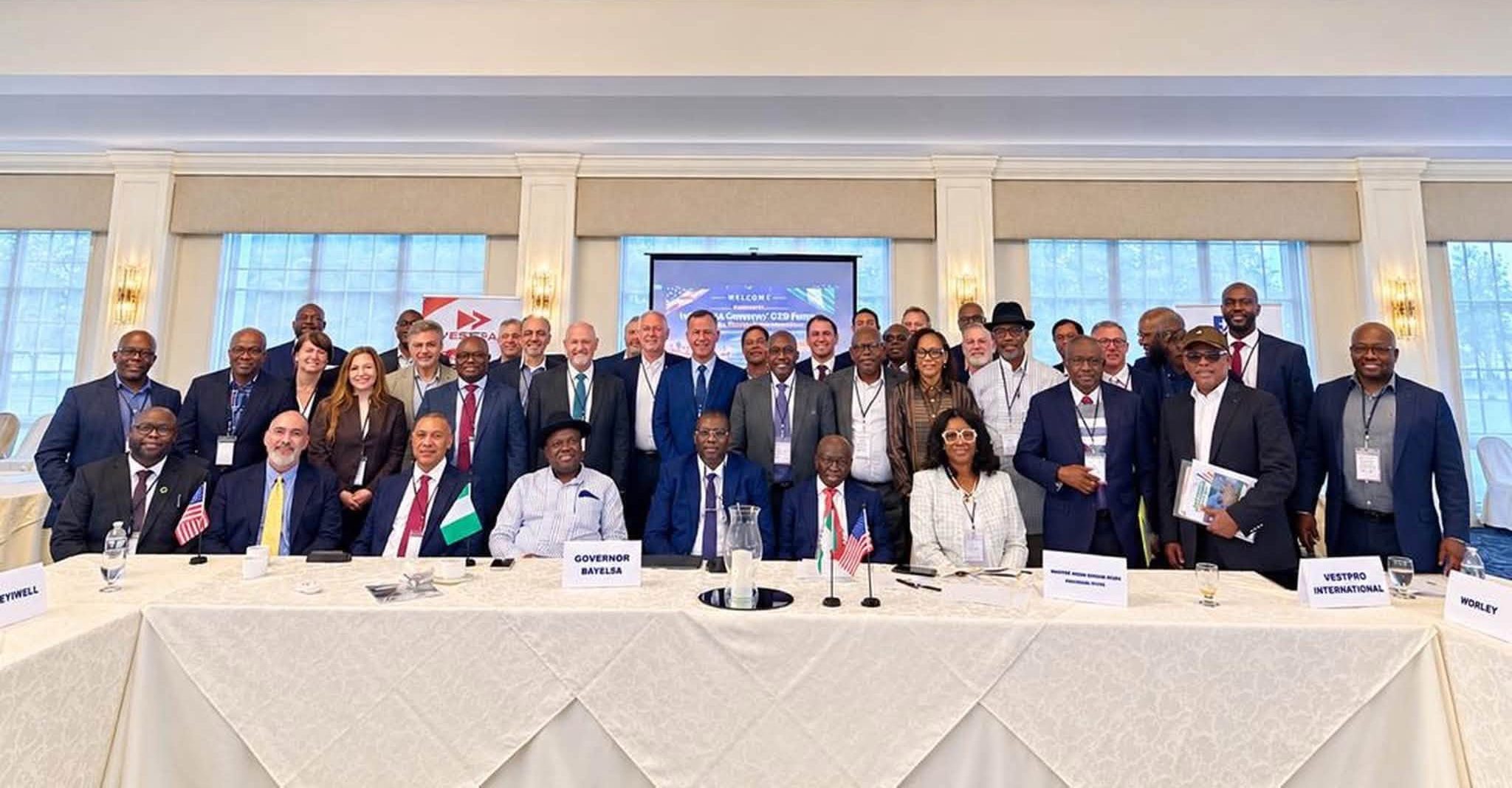
Bayelsa, US Firm Sign Multi-Million-Dollar Gas Deal to Tackle Flaring
Bayelsa, US Firm Seal Multi-Million-Dollar Deal to Develop Gas Processing Facility
The Bayelsa State Government has entered into a multi-million-dollar partnership with US-based energy company, Fulcrum LNG Incorporated, to establish a gas gathering and processing facility aimed at reducing gas flaring, addressing environmental pollution and supporting industrial development in the state.
The agreement was reached on Wednesday, November 11, at the conclusion of the inaugural two-day US-Nigeria Governors Government-to-Business (G2B) Forum on Energy, Mining and Infrastructure held at the Sweet Water Country Club, Sugar Land, Texas, United States.
The partnership will be implemented in phases, beginning with the collection and commercialisation of gas currently being flared. The gas will be used to support Bayelsa’s Independent Power Plant and emerging industrial clusters, while reducing the environmental consequences of gas flaring.
A subsequent phase will involve the development of an integrated gas monetisation strategy to harness the state’s substantial natural gas reserves.
Fulcrum LNG to Conduct Assessment of Bayelsa Gas Flare Sites
Speaking after a closed-door meeting with Governor Douye Diri, Fulcrum LNG Chief Executive Officer, Mr Jesus Bronchalo, said the governor’s presentation at the roundtable attracted his company’s interest, describing the proposed partnership as an opportunity with significant prospects for both parties.
Bronchalo disclosed that the company would commence a comprehensive assessment of gas flare locations across Bayelsa to determine the appropriate technology and infrastructure required to gather and process the gas.
He explained that a similar project being undertaken by Fulcrum LNG in Guyana was valued at approximately $3 billion, adding that the potential investment in Bayelsa would be determined after the feasibility study and could exceed the scale of its South American operations.
According to him, the period from Final Investment Decision (FID) to commissioning is expected to take approximately 12 months.
“From FID to commissioning will take about 12 months,” Bronchalo said.
Explaining the need for an initial assessment, he stated:
“First, we need to understand the problem on the ground – where those facilities are and why gas is being flared. We will come to Bayelsa to understand the magnitude.
“Some flares may be so remote or uneconomic that gathering may not be viable. The key question is whether the flaring is due to lack of infrastructure to move the gas or lack of re-injection capacity. Once we know that, we can determine the best option.
“The way we do it, we invest 100 percent. If government wants equity, then it brings capital for that portion.”
Diri Says Partnership Will Address Environmental Pollution, Boost Industrialisation
Reacting to the agreement, Governor Douye Diri described the partnership as a win-win arrangement and assured the company of his administration’s commitment to ensuring that implementation begins without delay.
The governor noted that his administration had approximately 15 months remaining in office, stressing the importance of moving quickly from agreement to implementation.
He said the project was particularly important to Bayelsa because of its potential to address environmental pollution and strengthen the state’s industrialisation efforts.
“Our interest is how this project will reduce the effects of environmental pollution on our people and boost our industrialisation drive.”
Diri Highlights Bayelsa’s Gas Reserves and Agge Deep Seaport Potential
Earlier, during his presentation at the investment roundtable, Governor Diri highlighted Bayelsa’s strategic position in Nigeria’s energy industry, stating that the state accounts for an estimated 15 to 20 per cent of the country’s proven natural gas reserves.
He also disclosed that Bayelsa supplies approximately 60 per cent of the gas utilised by the Nigeria LNG Limited (NLNG) facility in Bonny, Rivers State.
The governor further drew attention to Bayelsa’s 203-kilometre Atlantic coastline, which he described as the longest in Nigeria, noting its direct access to the Gulf of Guinea.
On maritime infrastructure, Diri highlighted the proposed Agge Deep Seaport, describing it as a natural deep seaport that requires no dredging.
He also presented the facility as Nigeria’s deepest natural port and a natural first port of call for vessels entering the country.
Westpaq International Commends Outcome of US-Nigeria Governors’ Forum
The facilitator of the forum and Chief Executive Officer of Westpaq International, Mr Samuel Diminas, expressed satisfaction with the outcome of the engagement.
Diminas commended Senator Ben Murray-Bruce for his contributions towards ensuring the success of the forum.
He also assured that Westpaq International would continue engaging the relevant parties to facilitate the timely commencement of the project.
According to him, the proposed investment presents substantial economic opportunities for Bayelsa State and Nigeria.
The inaugural US-Nigeria Governors G2B Forum was facilitated by Westpaq International in collaboration with the United States Department of Commerce and the US Commercial Service in Houston.
The event brought together Governor Diri, representatives of Nasarawa, Ogun and Ondo States, as well as more than 15 leading American energy, mining and financial companies.
Among the participating companies were Honeywell, KBR, Worley, Lummus Technology and VGas.
Also Read: George Turnah Accuses Bayelsa Governor Douye Diri of Corruption, Poor Governance, Working Against Tinubu
Members of Governor Diri’s delegation included the Honourary Adviser on Oil and Gas, Dr Daru Owei; Managing Director of Bayelsa State Electricity Company Limited, Engr Olice Kemenanabo; Director-General of the Bayelsa Investment Promotion Agency, Patience Abah; former Secretary to the Bayelsa State Government, Mr Kemela Okara; and Chief Executive Officer of Century Energy Group, Chief Ken Etete.
PulseNets learnt that the proposed partnership is expected to begin with a technical assessment of gas flare sites before the investment requirements, infrastructure and implementation framework are established.
However, the actual investment value, specific project locations and final implementation arrangements remain subject to the outcome of the feasibility study.