Dust, Stones and Toxins: Experts Reveal Risks Involved With Nigeria’s Roadside Food Drying
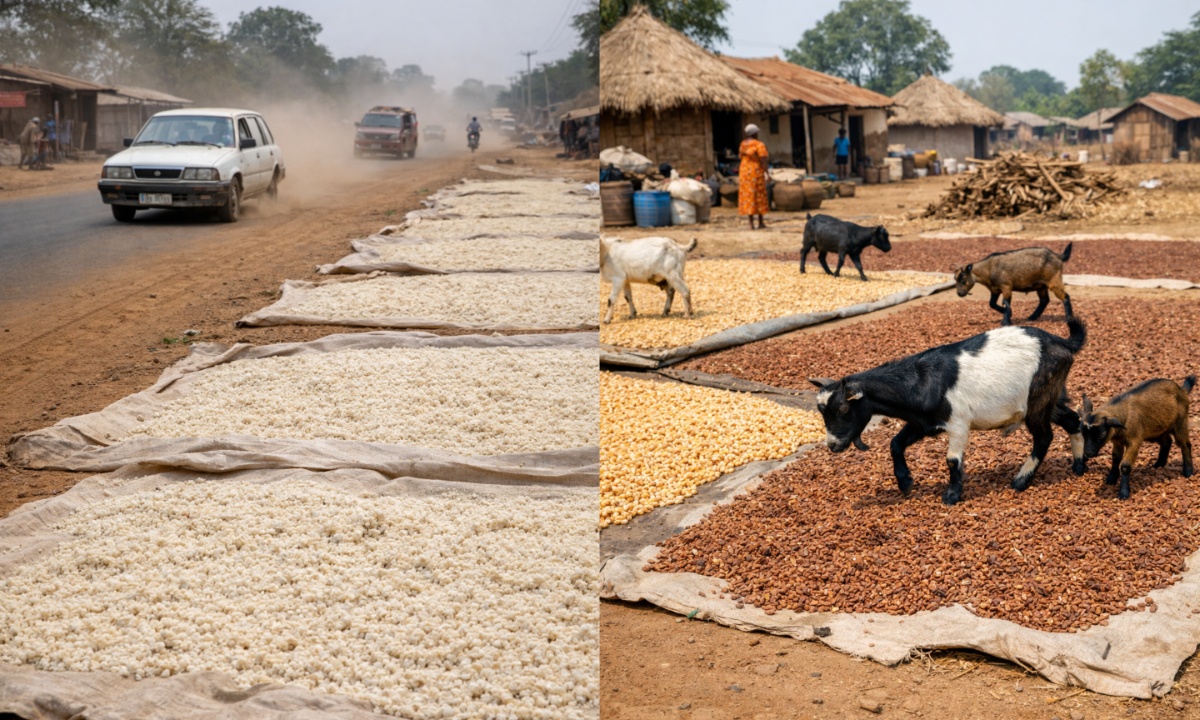
Along Nigeria’s highways and rural roads, rows of cassava mash, maize, rice, beans, pepper and melon seeds are routinely laid out under the open sun, stretching for kilometres.
To many farmers and small-scale processors, the practice is cheap, familiar and convenient. To public health professionals, however, it represents a quiet but dangerous pathway through which disease enters the food chain.
From Ogun, Ondo and Oyo in the South-West to Benue, Kogi and Niger in the North-Central; from Imo, Enugu and Ebonyi in the South-East to Adamawa, Taraba and Yobe in the North-East, roadside drying has become deeply embedded in daily agricultural life.
It cuts across regions, cultures and crops, transforming busy transport corridors into improvised drying floors.
As vehicles speed past, clouds of dust rise and settle directly on food meant for markets and family kitchens. Animals roam freely around the produce, while the bare soil itself becomes a source of contamination. What appears normal, health experts warn, is a nationwide habit silently travelling from highways to dining tables.
Dust Is Not Just Sand
In a cassava-processing community, PulseNets learnt that roadside drying is often driven by space constraints rather than ignorance.
Standing beside trays of fermenting cassava, a garri processor, Mrs. Adebisi, explained the choice plainly: “We don’t have enough space at home, and the sun is stronger near the road. We spread it here and watch it until evening.”
Environmental health expert, Sani John, warned that the dust settling on exposed food is far from harmless. He told PulseNets: “Dust from moving vehicles contains carbon, oil residues and sometimes heavy metals like lead.”
According to him, “Once these particles enter food, washing later cannot remove everything. People consume it little by little and damage their bodies without realizing it.”
He added that repeated intake of contaminated food can trigger stomach infections, weaken immunity and, over time, lead to serious organ damage.
When Animals Walk Through Food
At several drying points observed by PulseNets, goats and chickens were seen stepping directly on fermented cassava, rice and beans meant for sale.
Nutritionist Mrs. Helen Okorie decried the practice, noting that animals introduce bacteria, parasites and faecal matter once they come in contact with food.
She explained: “That food is no longer safe. Many cases of diarrhoea, typhoid and intestinal worms are linked to such unsafe processing. The bare ground itself harbours fungi, especially when drying is slow.”
Okorie also warned that certain moulds produce aflatoxins — toxic substances associated with liver cancer and stunted growth in children.
Grains such as rice and beans, she noted, easily trap moisture and dirt, making them particularly vulnerable to mould and bacterial contamination.
Stones, Dust and Grains
Beyond cassava and maize, rice and beans are frequently spread along highways or bare ground after washing or harvest. Along these routes, gravel, stones and dust mix freely with grains destined for cooking pots.
Each passing vehicle blows fine particles and tiny stones straight into the produce. What consumers later spend hours sorting in the kitchen often begins on the roadside.
A grain trader, Mrs. Fatima Kudu, told PulseNets: “People complain about stones in rice and beans and think it’s only from the farm. Many of those stones actually enter during roadside drying and packing.”
A Hidden Road Safety Risk
Commercial driver Mr. Ibrahim Lawal said roadside drying also poses dangers to motorists.
He explained: “Sometimes the food spreads onto the road. Drivers swerve to avoid it, and accidents can happen.” He added that “when vehicles crush the food, both farmers and traders lose money.”
The economic impact is also felt in the markets. A trader, Mrs. Funke Ade, said buyers often reduce prices when produce looks dirty.
She noted: “Once buyers see sand in garri, they complain and cut the price. We lose profit immediately.”
Hospitals Bear the Burden
A community health worker in Osun State, Mrs. Desola Dotun, linked unsafe drying practices to rising cases of food-borne illness.
She told PulseNets: “Many people think sickness starts in the kitchen, but it often starts from the drying ground. We treat patients for stomach upset, food poisoning and intestinal worms almost daily.”
According to her, prevention remains cheaper than treatment, stressing that food safety is a core public health issue, not just an agricultural concern.
Medical and Nutrition Warnings
Dr. Fredrick Agbo, Medical Director and Chief Executive of Talakawa Pharmacy, warned that roadside drying exposes food to multiple hazards, including bacterial and fungal growth, carcinogenic aflatoxins, insect and rodent infestation, disease-causing pathogens and chemical contamination from vehicle exhaust.
He told PulseNets: “We treat food poisoning, chronic stomach infections and even liver complications. People blame water or cooking, but the real problem often begins at the drying stage.”
Dr. Agbo advised processors to adopt safer options such as raised platforms, clean tarpaulins, solar dryers, covered drying areas and proper storage. He also called on government to provide support to reduce the health risks associated with open sun-drying of foodstuffs.
Mrs. Okorie reinforced the warning, saying: “Nutrition is not just about what you eat, but how it is processed.”
She added: “Children may eat garri, rice or beans daily, but if those foods carry toxins from poor drying, growth and immunity suffer.”
The Director of Public Health at the Niger State Ministry of Health, Dr. Ibrahim Idris, also cautioned that food dried openly along roadsides or on bare ground faces serious contamination risks.
He said such produce is easily exposed to dust, birds, rodents and harmful microorganisms, making it unsafe for direct consumption.
Dr. Idris advised that sun-dried food should undergo proper cooking such as boiling or frying before eating.
He warned: “If people must sun-dry, the food should be covered with mesh and never eaten directly.” He noted that garri, though fried, is often re-exposed to the sun and consumed without reheating, increasing the danger.
According to him, animals roaming freely can urinate or defecate on exposed food, while passing vehicles continuously raise dust that settles on produce along highways.
He stressed that drying food openly without protection and consuming it without reheating poses a serious public health threat that demands better handling practices from both processors and consumers.
Support, Not Blame, for Farmers
An agricultural extension officer, Mr. Peter Danjuma, said farmers are not careless but constrained by lack of alternatives.
He explained that most rural processors do not have access to drying platforms or solar dryers.
He told PulseNets: “If government and NGOs provide simple raised platforms and basic training, roadside drying will reduce significantly.”
Danjuma recommended community drying centres and enforcement of minimum food safety standards.
Mrs. Adebisi also admitted the challenge, saying: “We know dust enters the cassava, but if we stop drying, it will spoil. We need help, not punishment.”
Niger State Begins to Respond
PulseNets learnt that community leaders in Niger State have begun openly condemning unsafe handling of food crops and urging farmers and processors to adopt cleaner practices.
The call was made during a sensitisation programme in Mokwa organised by the Federal Government, Niger State, IFAD and the Value Chain Development Programme (VCDP), targeting farmers from Lavun, Edati and Mokwa local government areas.
A health worker at IBB Specialist Hospital, Minna, Nurse Leah Hassana Yisa, warned participants: “Drying cassava, rice or beans on roadsides exposes food to vehicle dust, stones and animal waste, increasing the risk of food poisoning, cancer and intestinal problems, including appendicitis from swallowed stones.”
Chairmen of Lavun and Mokwa LGAs, represented by Mal. Lawan Mohammed and Hon. Abubakar Usman, described the programme as impactful.
They said: “Our councils will support farmers to replicate what they have learnt in their communities.”
Religious leaders also joined the campaign. The Chief Imam of Mokwa, Alhaji Musa Ibrahim, declared: “What you will not eat yourself, do not give to others.”
Mrs. Elizabeth Yisa, Business, Marketing and Development Officer of VCDP in Niger State, announced concrete support measures.
She said: “We are not only talking. Tarpaulins and cement floors will be provided so farmers can change their practices.”
Farmers Mrs. Aisha Mohammed and Lami Nakotsu responded after the programme, saying: “We were careless before. Now we will use cement floors and tarps — no more roadsides.”
A National Pattern, Not an Isolated Problem
PulseNets observation shows that roadside drying is not a single mistake but a chain of risk connecting dryers, traders, transporters, regulators and consumers.
Nigeria’s most common foods are often first laid on dusty highways before reaching the markets. In that brief stage, grains absorb stones, exhaust fumes, animal waste, bacteria and toxic fungi.
For processors, the roadside becomes a workspace born out of necessity. For nutritionists and health experts, it is a contamination zone. For hospitals, it quietly feeds disease statistics. And for government, it exposes the gap between agriculture and public health policy.
Health experts warn that pollutants and microorganisms introduced during drying accumulate in the body over time. Nutritionists caution that aflatoxins and bacteria undermine child development and adult immunity.
Doctors confirm that what starts as ordinary garri, rice or beans can end as diarrhoea, typhoid, intestinal worms, stomach injuries from swallowed stones and even long-term organ damage.
Also Read: Pentagon Opens New Military Front in Nigeria as US Intensifies Fight Against Islamic State Terrorists
The steps taken in Niger State offer a possible model — supporting processors with platforms and solar dryers, educating traders, inspecting markets and involving community and religious leaders to change long-standing habits.
Without sustained national commitment, roadside drying will remain Nigeria’s unofficial food processing system.
Until farmers and processors are supported and regulated, the dust of Nigerian highways will continue to find its way into daily meals, quietly turning a livelihood practice into a growing public health risk.