INEC Removes 1.6 Million Voter Records, Identifies 54 Staff in 10 States Over Registration Irregularities
The Independent National Electoral Commission (INEC) has removed more than 1.6 million records from Nigeria’s national register of voters following a clean-up of the 2025/2026 Continuous Voter Registration (CVR) exercise, while identifying 54 personnel across ten states allegedly involved in registration irregularities.
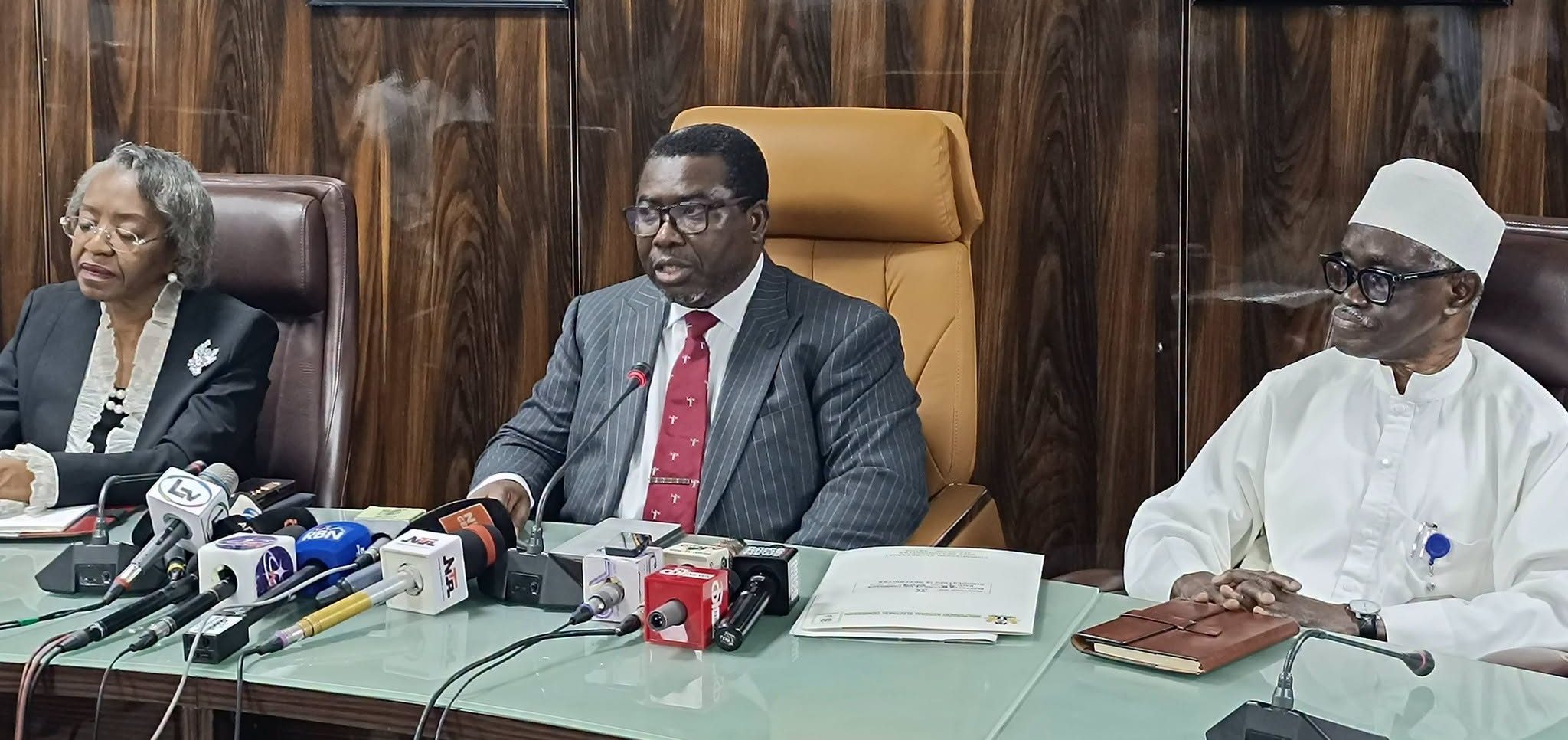
INEC Chairman, Professor Joash Amupitan, SAN, disclosed this on Monday, 9 November 2026, during a press conference at the Commission’s headquarters in Abuja, where he provided updates on the cleaning of the voters’ register, investigations into alleged registration fraud and preparations for the 2027 general elections.
PulseNets learnt that the Commission harvested 11,088,238 registration records across the three phases of the 2025/2026 CVR exercise, out of which its Automated Biometric Identification System (ABIS) initially flagged 1,545,052 records for further examination.
However, Amupitan cautioned that being flagged by the automated system did not automatically make a registration invalid, explaining that each case had to undergo proper verification and adjudication.
“A flagged record is not necessarily an invalid registration: automated screening identifies matters requiring review, while authorised adjudication determines the outcome,” he said.
INEC Explains Removal of 1.6 Million Voter Records
The INEC chairman explained that before the publication of the Preliminary Register of Voters, 1,277,052 registrations had already been confirmed invalid and excluded from the register.
Following the display of the preliminary register, the Commission received objections, claims and complaints, resulting in the adjudication of an additional 268,000 cases.
Of these, 217,722 registrations were confirmed invalid and removed, while 50,278 were cleared as valid and retained.
A further screening exercise subsequently identified another 113,886 invalid registrations, which were also removed. This brought the total number of invalid registrations removed from the 2025/2026 CVR records to 1,608,660.
The Commission also removed 873 records belonging to verified deceased persons as a separate category.
INEC consequently announced that a total of 1,609,553 records had been removed from the register.
“The Commission confirms that the current register-cleaning exercise for the 2025/2026 Continuous Voters Registration (CVR) has been concluded,” Amupitan said.
54 INEC Personnel Identified Across 10 States
Addressing concerns over the scale of the irregularities, Amupitan said the Commission considered the number of invalid registrations significant enough to warrant an investigation into how the violations occurred and who was responsible.
He explained that the technical assessment examined suspected multiple registrations, unusual registration patterns, substituted photographs and irregularities in registration transactions.
According to him, the investigation established that some registration personnel deliberately violated established procedures.
“The Commission found instances in which certain registration personnel deliberately circumvented established registration procedures and misused provisions intended for exceptional registration circumstances including for persons with disabilities,” he said.
The chairman disclosed that the affected records had been identified, reviewed and subjected to corrective measures, while the personnel implicated had been identified for further administrative investigation.
“Fifty-four persons cutting across ten States have been identified as complicit and necessary disciplinary action will be taken against them including possible prosecution,” he said.
PulseNets reports that the Commission intends to strengthen its registration processes through improved biometric capture, authentication and verification safeguards to prevent a recurrence of the irregularities.
Public Complaints Raise Concerns Over 2027 Elections
The announcement followed complaints, claims and objections submitted during the display of the Preliminary Register of Voters at the ward level between 9 and 15 October 2026, as well as its subsequent online publication.
Members of the public raised concerns about photographs suspected to have been artificially generated or manipulated, duplicate registration attempts, unusual names and registration patterns, and deceased persons allegedly remaining on the voters’ register.
Some complainants also alleged that the irregularities were deliberate attempts to compromise the credibility of the 2027 general elections.
Amupitan said the Commission waited for the expiration of the 14-day statutory period provided under Section 19(2) of the Electoral Act, 2026, before making its formal response.
He announced that the Final Register of Voters would be published on 15 December 2026, noting that final reconciliation, quality assurance and publication checks were still required to ensure that all approved corrections were properly reflected.
INEC Admits Historical Problems With Voters’ Register
Despite the conclusion of the current cleaning exercise, the INEC chairman acknowledged that removing invalid registrations from the 2025/2026 CVR exercise would not resolve the wider problems affecting the national register.
He explained that many of the duplicate names and photographs circulating on social media originated from previous registration exercises conducted between 2011 and 2023.
“Cleaning the register of only the 2025/2026 Continuous Voter Registration (CVR) exercise alone will not solve the problem identified,” he said.
According to the chairman, Nigeria’s current voters’ register developed through successive registration and continuous voter registration exercises since 2011, using biometric and demographic information captured under different technologies, operational arrangements and quality standards.
He acknowledged that these historical processes had created integrity concerns requiring a broader intervention.
“Significant historical integrity questions remain since 2011 and require a national, systematic response.”
PulseNets understands that the Commission has now resolved to address the historical duplication issues in the older register, following a decision taken at its meeting on Monday, 9 November 2026.
Amupitan said cases previously identified through public complaints, alongside obvious instances of duplication, would be subjected to proper verification before being removed.
INEC Explains Postponement of Nationwide Voter Revalidation
The chairman also addressed the Commission’s earlier decision to defer its proposed nationwide voter revalidation exercise.
INEC had announced the exercise in February 2026 but subsequently postponed it until after the elections following concerns from stakeholders about its proximity to the 2027 general elections and the potential impact on voter participation.
Amupitan maintained that postponing the nationwide exercise did not mean the Commission had abandoned its responsibility to maintain an accurate register.
“did not suspend the Commission’s existing mechanisms for maintaining the integrity of the Register,” he said.
He pointed to biometric screening, adjudication and the statutory procedures for claims and objections as existing mechanisms through which the Commission could identify and correct irregularities.
INEC Explains Why Some Voters Cannot Find Their Names
Responding to complaints from Nigerians who claimed their names had disappeared from the voters’ register, Amupitan said many of the affected individuals had originally registered between 2011 and 2023.
He explained that rather than applying for a transfer of their existing voter registration to a new location, some individuals registered afresh.
According to him, the ABIS system identified and voided those subsequent registrations, but their original registration records remained at their previous polling locations.
The chairman therefore advised affected voters to check the locations where they initially registered instead of assuming that their records had been completely deleted.
INEC Gives Update on Permanent Voter Card Distribution
On the distribution of Permanent Voter Cards (PVCs), Amupitan said the Commission was continuing the distribution of cards from the first and second phases, alongside cards belonging to voters who applied for transfers.
He disclosed that some PVCs from the third and final phase were already being delivered and would be dispatched to the states by the following week.
According to him, distribution would return to the Registration Areas from 1 December 2026.
The chairman appealed to voters who participated in the third phase to exercise patience, explaining that the cards were produced outside Nigeria.
INEC Assures Nigerians Against Multiple Voting
Amupitan also assured Nigerians that the Commission had established safeguards to prevent multiple voting on election day.
He explained that under INEC’s Standard Operating Procedures for Presiding Officers, supported by the Bimodal Voter Accreditation System (BVAS), every voter must be physically present at their designated polling unit and undergo biometric authentication.
Also Read: Tinubu Defends Policies, Blames Atiku, Past Governments for Nigeria’s Economic Crisis
The authentication process, he said, would be conducted through fingerprint or facial recognition.
“The Commission remains committed both to removing confirmed invalid entries and to protecting eligible Nigerians from wrongful exclusion,” he said.
He further assured Nigerians that the Commission would continue to provide information on the outcome of its register-cleaning exercise without compromising personal information or ongoing investigations.
“will continue to communicate verifiable aggregate outcomes while protecting personal information and the integrity of ongoing investigations.”