5% Petroleum Tax: TUC Gives FG 14 Days to Withdraw or Face Nationwide Strike
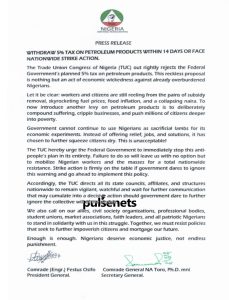
Petroleum Tax — Nigeria’s labour movement has once again drawn a red line for the Federal Government. The Trade Union Congress of Nigeria (TUC) has categorically rejected the planned 5% tax on petroleum products, describing it as “an act of economic wickedness against already overburdened citizens.”
In an official statement obtained by PulseNets from the TUC National Headquarters, the union warned that it will not stand by while workers and ordinary Nigerians are subjected to what it called “deliberate punishment disguised as policy.” With inflation spiraling, fuel prices skyrocketing, and the naira collapsing, the TUC declared that introducing a fresh levy would push millions further into poverty.
The 14-Day Ultimatum
The TUC, PulseNets learnt, has issued a 14-day ultimatum to the Federal Government. Within this period, authorities must withdraw the planned tax or face a nationwide strike that could paralyze economic activities.
“The TUC hereby demands an immediate halt to this anti-people’s plan. If government ignores this warning, Nigerian workers and the masses will be fully mobilized for resistance. Strike action is not just on the table; it will be inevitable if this policy is implemented,” the statement emphasized.
This ultimatum places the Federal Government on edge, as previous labour protests over fuel subsidy removal have already shaken public confidence in its economic management.
Why the TUC Is Opposed to the Petroleum Tax
PulseNets analysis shows that the opposition from the TUC is not just about taxation, but about timing and context. Nigerians are currently grappling with:
-
Fuel Subsidy Removal Fallout: Pump prices have tripled since subsidy removal, placing unbearable pressure on households.
-
Food Inflation: Prices of basic goods like rice, garri, and bread have soared, with inflation now at record highs.
-
Currency Crisis: The naira’s freefall has reduced purchasing power, making imported goods nearly unaffordable.
-
Business Struggles: Small and medium-sized enterprises (SMEs) are shutting down due to high operating costs.
“Government cannot continue to treat Nigerians as sacrificial lambs for failed economic experiments. Instead of bringing relief, jobs, and practical solutions, it has chosen to squeeze the very life out of citizens. This is unacceptable,” the union leadership told PulseNets.
The TUC insists that adding a new 5% petroleum tax will compound existing economic misery, cripple businesses further, and deepen poverty levels nationwide.
Economic Impact of Another Fuel Levy
Experts who spoke to PulseNets explained that the proposed 5% levy will have a ripple effect across the economy:
-
Transport Costs Will Skyrocket – With petrol prices already beyond reach, another tax would raise transport fares, worsening commuting hardship.
-
Food Prices Will Surge – Since agriculture depends heavily on transportation, market prices for food will rise further.
-
Manufacturing Sector Will Shrink – Manufacturers reliant on petroleum for production and logistics will face higher costs.
-
Job Losses Are Inevitable – With businesses struggling to cope, mass layoffs could follow.
-
Household Poverty Will Deepen – The average Nigerian family will spend even more on energy, leaving less for food, healthcare, and education.
This explains why the TUC insists the policy is anti-people and anti-business, warning that Nigerians cannot endure another round of government-imposed hardship.
Mobilizing Nationwide Resistance
To prepare for a showdown, the TUC has directed its state councils, affiliates, and grassroots structures nationwide to remain on alert. PulseNets reported that the union is quietly mobilizing its networks ahead of the ultimatum’s expiration.
“All our state councils, affiliates, and structures nationwide must remain vigilant, watchful, and ready for decisive action if government dares to ignore the collective will of the people,” the union declared.
The TUC also extended its call to allies across Nigeria, including:
-
Civil society organizations
-
Student unions
-
Market associations
-
Professional bodies
-
Faith-based leaders
-
Patriotic citizens
The union stressed that this is not just a workers’ struggle but a national fight for survival and economic justice.
So far, the Federal Government has not issued an official response to the TUC’s ultimatum. Economic analysts told PulseNets that silence may be a tactic to buy time, but warned it could backfire if Nigerians interpret it as arrogance or disregard.
Labour watchers say the government’s options are limited. With dwindling revenues, it is under pressure to raise funds, yet further taxing petroleum risks igniting nationwide unrest.
The standoff between the TUC and government highlights the fragility of Nigeria’s economic recovery strategy. Key points stand out:
-
Policy Disconnect: Many Nigerians believe government policies are detached from the realities on the ground.
-
Public Trust Erosion: Labour’s warning is a reflection of growing frustration that government policies serve elites rather than ordinary citizens.
-
Risk of Unrest: With poverty deepening, a strike could easily escalate into mass protests similar to the #EndSARS demonstrations.
-
Political Consequences: If unrest spreads, political stability could be threatened, further complicating governance.
PulseNets learnt that economic experts have long advised the government to focus on production-driven solutions, such as boosting agriculture, reviving local refining, and investing in jobs, rather than overtaxing a struggling population.
Voices from the Streets
PulseNets correspondents in Lagos, Port Harcourt, and Abuja sampled opinions from ordinary Nigerians.
-
A commercial driver in Lagos said: “We are already paying too much for fuel. If they add another tax, I will park my bus. How do they expect us to survive?”
-
A market woman in Port Harcourt told PulseNets: “Everything is expensive. Adding another tax means food prices will double again. We are tired of this government.”
-
A student in Abuja added: “They promised to help us, but instead they keep punishing us. If TUC calls for a strike, we will join.”
These sentiments reflect widespread anger and set the stage for possible large-scale civil disobedience.
Possible Fallout of a Nationwide Strike
If the government fails to withdraw the policy, the strike could have far-reaching consequences:
-
Airports, banks, and schools could shut down.
-
Electricity workers may join in, leading to blackouts.
-
Healthcare delivery could be paralyzed.
-
Ports and logistics hubs may grind to a halt.
-
Daily economic output could drop by billions of naira.
The TUC is banking on the sheer weight of solidarity from workers and citizens to force the government’s hand.
The press release was jointly signed by:
-
Comrade (Engr.) Festus Osifo – President General
-
Comrade General NA Toro, Ph.D., mni – Secretary General
Both leaders have in recent months adopted a more confrontational stance against government policies they consider exploitative, promising to defend Nigerian workers at all costs.
Also Read: Presidency speaks on introduction of Petroleum Tax, higher taxes, levies
The TUC’s ultimatum is more than just a warning; it is a direct challenge to the Federal Government’s economic direction. Nigerians are demanding relief, not more punishment.
“Enough is enough. Nigerians deserve economic justice, not endless suffering,” the union declared.
As the 14-day deadline ticks down, the question remains: Will the Federal Government retreat, or will Nigeria be plunged into yet another nationwide strike that could cripple the economy?
One thing is certain – the coming days will test the resilience of both government and the people.