Makoko in Crisis: Demolition Leaves Thousands Homeless as Lagos Government, Residents Clash
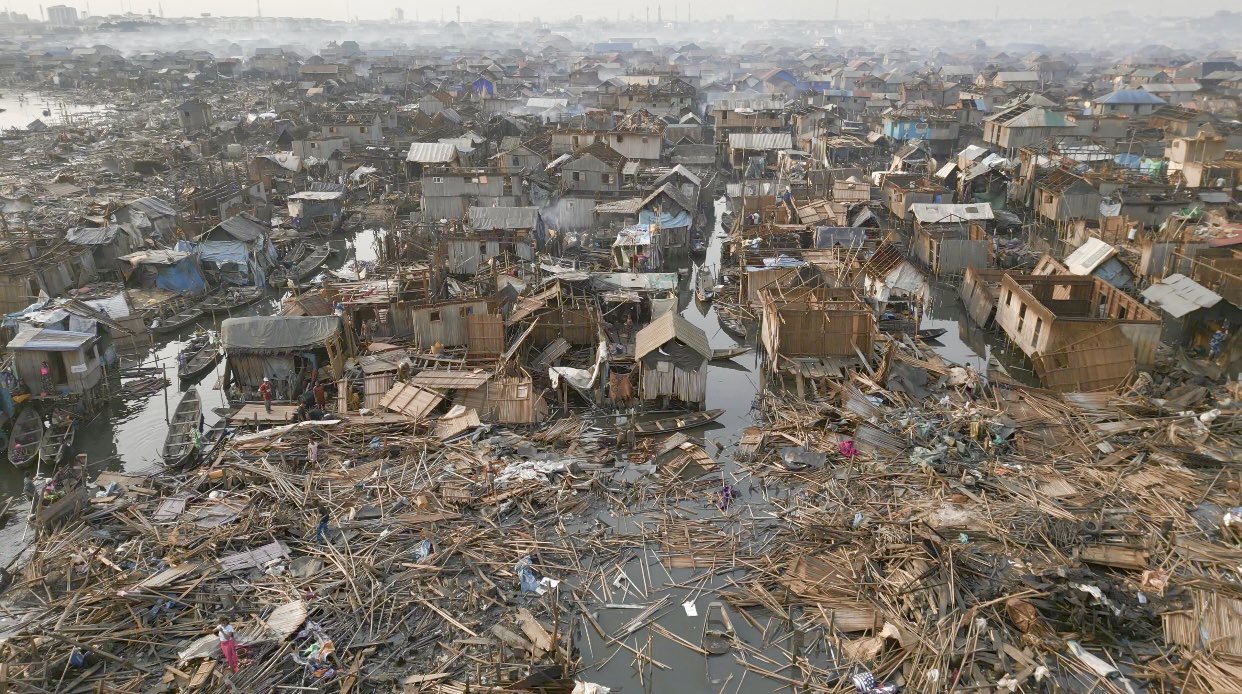
Makoko, the centuries-old waterfront fishing settlement in Lagos, has descended into humanitarian distress following a sustained demolition exercise carried out by the Lagos State Government.
Across the lagoon community, thousands of residents — predominantly women, children, widows, and elderly persons — have been displaced, with many now forced to sleep inside canoes, on bare planks, or under the open sky beside the water.
Rows of wooden homes, shops, and fishing sheds have been flattened, leaving splintered timbers, ruined household belongings, and families struggling to survive amid uncertainty.
Often referred to as Africa’s largest floating slum, Makoko is inhabited by fishermen, fish traders, artisans, and small-scale entrepreneurs whose livelihoods are inseparable from the lagoon. For many, the demolitions have not only erased their homes but also destroyed the economic foundation that sustained their families.
Makoko Demolition reportedly began quietly in December
PulseNets learnt that the demolition did not begin suddenly. Several residents said structures in parts of Makoko were first pulled down as far back as December 2025, long before the crisis attracted widespread public attention.
According to accounts obtained by PulseNets, the exercise expanded gradually, with bulldozers advancing deeper into the settlement without meaningful consultation or dialogue.
“They started from one corner and kept advancing bit by bit,” said Mr. Sunday Adebayo, a community elder who has lived in Makoko for over 20 years.
“At first, we believed it would stop. But each day, another house went down. By January, it became clear they wanted to clear everything, all in the name of development. Everything we owned disappeared,” he added.
Before the demolitions, residents survived through fishing, trading, and home-based microbusinesses. Today, those income sources have largely vanished.
A 35-year-old fisherman, Oyomide, who spoke to PulseNets, said feeding his family has become a daily struggle.
“This water is our life. I used to fish every morning, my wife smoked fish, and we sold little by little,” he said in Pidgin English.
“Once they destroyed our house, everything collapsed. My fishing net got damaged, my canoe almost sank. Since then, decent food has been rare in my house.”
A mother of four told PulseNets that hunger has become a constant companion.
“Before, even when money was scarce, we managed to eat,” she said tearfully.
“Now there is no shop, no work, no shelter. Sometimes my children sleep hungry. As a mother, it breaks me every night.”
Several residents said they lost cash savings, fishing equipment, goods, and household items during the demolition.
“They gave us no time at all,” an elderly resident said.
“My savings, mattress, radio — everything vanished with the house.”
“This is the only home we have ever known”
PulseNets obtained testimonies from residents who said Makoko is not just a settlement but their ancestral home.
A 52-year-old fisherman, Balogun Adekunle, said his family has lived in the community for over four decades.
“My father lived here. I was born here. I raised my children here,” he said.
“For more than 40 years, this has been our only home.”
Mrs. Bidemi, a widow with three children, said she has nowhere else to turn.
“My husband died five years ago in an accident near Ikorodu,” she said, sobbing.
“This house was all we had. Now it is gone. I have no family support. Where do they expect me to go?”
Sleeping in canoes, exposed to rain and illness
Since the demolitions began, displaced residents said no Internally Displaced Persons (IDPs) camp or temporary shelter has been provided by the state government.
When it rains, families are soaked. When the sun burns, there is no shade. At night, mosquitoes swarm freely as mothers clutch their children inside narrow wooden boats.
“If rain falls, it beats us. If the sun is hot, it burns us,” a trader said.
“They destroyed my shop and scattered my goods. How will my children eat now?”
Another young man told PulseNets:
“It’s not only me suffering this. Many people here are homeless now. Maybe the government does not want us to progress, because how do we start life all over again?”
A father of five said his children have begun falling sick frequently.
“They cough every night. Cold affects them badly,” he said quietly.
“We have no roof anymore. I fear what tomorrow holds.”
Some residents said attempts to seek refuge with relatives failed due to lack of money to contribute to feeding.
Allegations of night-time demolitions
One of the most disturbing claims by residents is that some demolitions occurred at night.
Multiple witnesses told PulseNets that bulldozers arrived at odd hours when families were asleep.
“It was past midnight when we heard loud sounds,” said Mr. Adekunle Hassan.
“Before we could react, houses were already coming down. People screamed. Children cried. Nobody listened.”
Others alleged that fires were set in some areas.
“They set houses ablaze while people were still inside,” alleged Mrs. Blessing Okonkwo, an Igbo trader whose shop was destroyed.
“We escaped with only the clothes we were wearing. Everything else burned.”
Children pulled out of school
Parents told PulseNets that many children have dropped out of school due to the loss of income, uniforms, and learning materials.
“My two children have stopped attending school,” said Mrs. Esther Ajayi.
“Their uniforms were destroyed and I have no money for transport or fees. I don’t know how to explain this to them.”
Teachers in nearby schools reportedly confirmed a sharp decline in attendance among Makoko pupils since January.
Deaths, trauma, and unanswered questions
Residents and civil society groups allege that at least 12 people have died due to stress, illness, and trauma linked to the demolitions.
PulseNets spoke to Mr. Ibrahim Lawal, whose younger brother reportedly died days after their home was destroyed.
“He was healthy before,” Lawal said.
“After the demolition, he became ill. We had nowhere to sleep and no money for treatment. He died quietly. Is this what development means?”
Mrs. Rukayat Bello said her elderly mother collapsed shortly after their displacement.
“The shock overwhelmed her,” Bello said.
“She kept asking where we would sleep. She couldn’t bear it anymore.”
While the Lagos State Government has not officially confirmed these deaths, residents insist the losses are real and devastating.
Government insists structures were under high tension
The Lagos State Government has maintained that the demolished buildings were erected under high-tension power lines, posing serious safety risks.
Governor Babajide Sanwo-Olu said the structures had long been marked and that residents were aware of the danger.
According to him, the exercise was necessary to prevent loss of lives and ensure public safety, adding that compensation plans were underway.
However, residents disputed this explanation.
“How can they claim safety when they destroyed houses far from the cables?” said Mrs. Funke Olawale.
“Some of the buildings they pulled down are over 500 metres away from any high-tension line.”
Lagos Assembly backs demolition amid outrage
On 20 January 2026, the Lagos State House of Assembly officially endorsed the demolition, dismissing protests by residents and civil society groups.
The Chairman of the House Committee on Information, Security and Strategy, Mr. Stephen Ogundipe, described the exercise as necessary.
“It is troubling that ramshackle structures have taken over shorelines,” Ogundipe said.
“These areas have become havens for criminal activities. While painful, the demolition is necessary to protect the larger society and uphold the rule of law.”
Residents, however, saw the endorsement as a refusal to listen.
“We protested. We pleaded. We carried placards,” said Mr. Adewale, a youth leader.
“But they chose development over our lives.”
Sanwo-Olu, Ezekwesili, and APC chieftain react
The crisis has triggered a national debate.
Former Education Minister Oby Ezekwesili condemned the demolitions, describing them as inhumane and unconstitutional.
“This is not about safety; it is systemic violence against the poor,” she said.
“A government that bends rules to justify destruction is betraying its citizens.”
Governor Sanwo-Olu countered by insisting the action was purely about safety and accused some NGOs of exploiting the situation for foreign funding.
“Some groups turn these crises into business opportunities,” the governor said.
“We are focused on safety, not fundraising.”
Civil rights groups rejected the claim, calling it an attempt to deflect responsibility.
Also Read: 12 years Bayelsa chess prodigy Deborah Quickpen to play Guinness World Record Holder, Tunde Onakoya
Similarly, APC chieftain Joe Igbokwe raised concerns about repeated demolitions affecting Igbo residents.
In a Facebook post, Igbokwe said he had received numerous distress calls.
“Hundreds of Igbo in Lagos have contacted me about losing their houses,” he said.
“I am overwhelmed and exhausted by this situation.”
He appealed to Governor Sanwo-Olu to find an amicable solution.
A future clouded by fear
As darkness settles over Makoko, fear and uncertainty linger. Fishermen stare at the water unsure of tomorrow. Traders wonder how to begin again. Parents lie awake worrying about their children’s next meal.
For now, Makoko remains suspended between loss and survival — a stark reminder that development, when poorly managed, can dismantle lives faster than it builds cities.