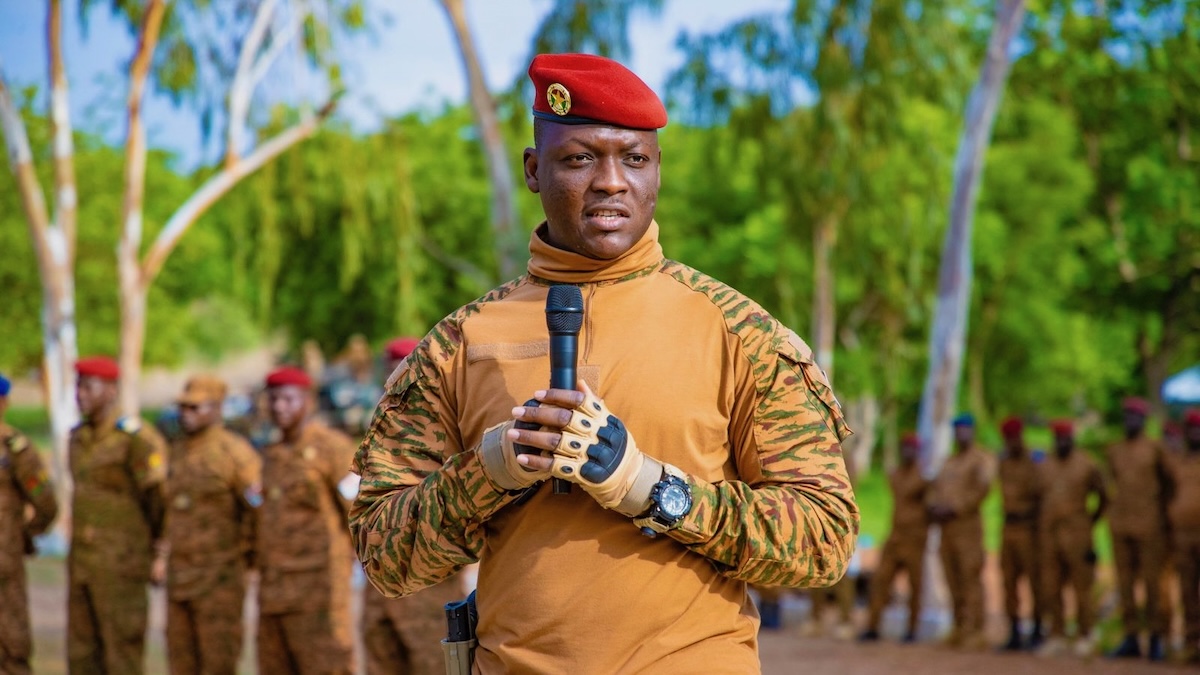
Ibrahim Traoré Rejects Religious Extremism, Defends Secular Burkina Faso Amid Sharia Debate
“I Am a Muslim, but Everyone in Burkina Faso Has the Right to Practise Their Religion”: Traoré Rejects Sharia Law and Religious Extremism
Burkina Faso’s military leader, Captain Ibrahim Traoré, has defended the country’s secular identity and warned against the use of religion to promote extremism, insisting that citizens must be free to practise their faith without imposing religious laws on others.
Traoré made the remarks on Thursday, 16 July 2026, during a meeting with representatives of the Forces Vives of the Yaadga region in Ouahigouya, where he addressed concerns about religious tolerance, national cohesion and the activities of young Burkinabè studying Islamic jurisprudence in foreign countries.
PulseNets learnt from reports of the meeting that the Burkinabè leader expressed concern over the growing number of young citizens travelling to Arab countries to study Sharia and Islamic law, allegedly without the knowledge of the country’s diplomatic missions or relevant authorities.
According to remarks reported by Senegalese news platform Seneweb, Traoré said more than 800 Burkinabè students had been identified in several Arab countries, with the figure potentially exceeding 1,000.
“Au moment où je parle, il y a plus d’un millier de jeunes burkinabè qu’on est en train de recenser dans plusieurs pays arabes. Les dernières statistiques que j’ai, c’étaient 800 et quelques. J’ai regardé la fiche. Personne n’est au courant de leur sortie, personne n’est au courant de ce qu’ils font. Les ambassades qui sont là-bas ne savent rien d’eux. Et vous savez ce qu’ils apprennent ? La Charia, les lois islamiques, la jurisprudence islamique,” he said.
Translated into English, Traoré said that more than 800 students had been identified in the latest records, while the total number could exceed 1,000. He questioned why the students were studying Islamic jurisprudence abroad without the knowledge of Burkinabè authorities.
The president also indicated that his administration intended to bring the students back to the country, warning that those who refused to return could face serious consequences regarding their national status.
“Ces gens-là, je vais les faire revenir. Celui qui ne va pas revenir, c’est qu’il n’est plus Burkinabé,” he reportedly declared.
Traoré further argued that religious education should be available within Burkina Faso, suggesting that local religious leaders could be supported to provide Islamic education alongside other forms of religious instruction.
He said the government could develop arrangements to support the religious education of Muslim, Christian and traditionalist communities, rather than allowing young people to travel abroad for training that he believes could expose them to extremist influences.
Traoré draws a line between religion and extremism
During the meeting, Traoré also criticised individuals who use religious differences to promote hatred and violence, arguing that faith should encourage good conduct and peaceful coexistence.
He questioned why people should be willing to attack or kill fellow citizens because they belong to another religious community.
“Nous les nègres sommes prêts à détester nos frères, à les tuer, parce qu’on dit qu’ils sont kafir,” he said, criticising the use of the term kafir, commonly used to describe non-believers, as a justification for hostility towards others.
He also warned religious extremists against promoting an interpretation of Islam that encourages violence and threatens national unity.
“Si c’est ça votre Islam-là, on va le combattre. Les extrémistes là, il faut vous ressaisir. Si vous ne vous ressaisissez pas, en tout cas, le combat est lancé,” Traoré said.
The remarks reflect his administration’s position that religious practice must not be used to undermine social cohesion or the authority of the state.
Burkina Faso’s constitution defines it as a secular state
Burkina Faso’s secular identity is not a new policy introduced by Traoré. Article 31 of the country’s Constitution defines it as a democratic, unitary and secular state.
The country’s constitutional framework also protects freedom of religion and belief, while its laws prohibit political parties organised along religious, ethnic or regional lines.
The United States Department of State’s 2023 International Religious Freedom Report similarly notes that citizens have the right to choose, change and practise their religion, subject to the law and public order.
Available demographic estimates indicate that Muslims constitute approximately 63.8 per cent of Burkina Faso’s population, while Christians account for about 26.3 per cent. Followers of traditional African religions make up a further proportion of the population.
The country has historically had a diverse religious population, with Muslim and Christian communities living alongside practitioners of traditional beliefs. However, the security crisis and attacks by jihadist groups have increasingly threatened religious communities and peaceful coexistence.
Sheikh Ahmad Gumi criticises Traoré’s position
Traoré’s remarks subsequently attracted criticism from Nigerian Islamic cleric Sheikh Ahmad Gumi, who questioned the Burkinabè leader’s understanding of the religious and political implications of his position.
In a post shared on his Facebook page, Gumi described Traoré as too young and inexperienced to understand the complexities of the society he governs and contemporary geopolitics.
He also warned that the president’s position could provide extremist groups with an opportunity to recruit more fighters.
“He has given the extremists the weapon they need to conscript more foot soldiers against his secular regime,” Gumi said.
The cleric’s comments were reported by Nigerian news platforms on 25 and 26 July 2026.
Important clarification on the alleged 200 mosques offer
Meanwhile, claims circulating online that Traoré rejected an offer from Saudi Arabia to construct 200 mosques in Burkina Faso, preferring schools, hospitals and industries instead, should not be treated as part of the verified July 2026 remarks.
A fact-check by Burkina Faso-based organisation Fasocheck found that the claim was false. The organisation traced it to a rumour that first circulated in October 2023 and was subsequently denied by Burkina Faso’s Ministry of Foreign Affairs.
Africa Check also investigated the allegation in March 2025 and reported that the ministry had described the supposed offer as false.
There is therefore no reliable basis for presenting the alleged 200-mosque offer as a confirmed event or as a decision made by Traoré during his July 2026 meeting.
The wider security context
Burkina Faso continues to face a prolonged insurgency involving jihadist armed groups, with attacks affecting communities, security personnel and religious institutions.
The conflict has caused extensive displacement and humanitarian hardship. The United States Commission on International Religious Freedom has documented attacks on religious communities and the deteriorating security situation, while noting that Muslims and Christians have both been affected by extremist violence.
Also Read: Burkina Faso’s Ibrahim Traoré Becomes First AES Leader to Receive Biometric Regional ID
Traoré’s comments therefore place religious tolerance and the state’s secular character within the wider debate over national security, foreign religious influence and the prevention of extremist recruitment.
His position, as expressed during the Yaadga meeting, is that religious belief should remain a matter of personal conviction and peaceful practice rather than a basis for violence or the imposition of a particular religious system on the country.
For a country with a Muslim-majority population and a significant Christian minority, the debate raises important questions about how religious freedom, national identity and security can be protected at the same time.