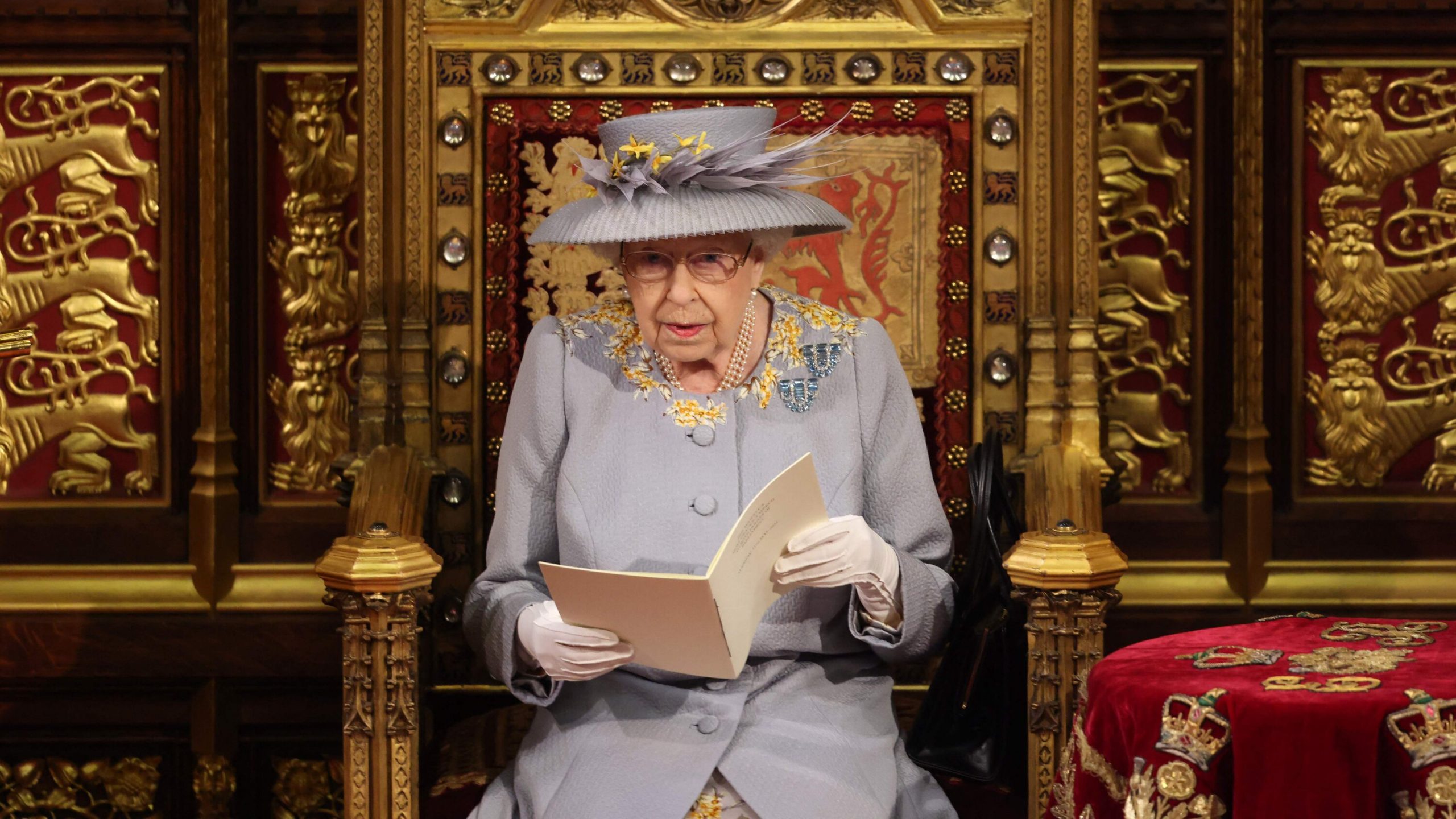
Queen Elizabeth II has died at 96. Here’s what happens next for the throne, currency, and more.
Queen Elizabeth II was the longest-reigning monarch in British history. She ascended to the throne in 1952 and reigned for 70 years, until her death on September 8, 2022.
For at least 12 days after her death, Britain will grind to a halt, potentially costing the UK economy billions in lost earnings.
But it’s not just the economy. Prince Charles may change his name, and the words of the national anthem will be updated.
In a statement sent to Insider, Buckingham Palace said the Queen “died peacefully at Balmoral” on Thursday afternoon.
Inside Buckingham Palace, arrangements for handling the Queen’s death and the subsequent succession were said to have been codenamed “London Bridge.” The Guardian reported that the plan for if she were to die at Balmoral was codenamed “Operation Unicorn.”
The detailed plan reportedly included a “call cascade” to alert Britain’s leaders of the queen’s death. The prime minister, the cabinet secretary, and the Privy Council Office were all to be informed, followed by an official public notification.
According to The Daily Beast, plans have long been in place to announce the Queen’s death at 8 a.m. in the event that she dies overnight.
The royal court has a staff hotline for distributing news and instructions to employees in case of a major event.
Most staff members at the palace and associated institutions will be immediately sent home once the announcement has been made, a former staff member of the palace told Insider.
Given Britain’s global presence through its embassies, former colonies, and the Commonwealth (which swears loyalty to the crown), the Queen’s death will be a top news story around the world.
The immediate official government response in the UK — beyond the expected statements of condolences — will be harder to predict, the former palace employee Insider spoke to said.
The last death of a monarch was in 1952; procedures that seemed apt then may be woefully antiquated in the 21st century. Mourners wore black armbands to show respect for King George VI, for example, but similar public displays of mourning may not be employed today.
Flags will be flown at half-mast until 8 a.m. the day after the funeral, according to guidance from the Greater London Lieutenancy, with the exception of Proclamation Day (more on that shortly). Churches may also toll their bells to mark the day of the Queen’s death or the day after.
The day of the funeral will be declared a bank holiday.
The London Stock Exchange is likely to close if the announcement happens during working hours, and other businesses may, too.
Following Princess Diana’s death in 1997, The Guardian’s Jonathan Freedland wrote that many Britons felt “forced to close their shops or cancel sporting events on the day of the funeral, lest they feel the rage of the tear-stained hordes outside.”
Given the Queen’s stature and how intrinsically she was woven into the fabric of modern Britain, there is likely to be even greater public mourning for her passing.
The protocols government bodies will follow will emanate from the Department of Culture, Media, and Sport (though they may also originate from the palace).
A former ambassador Insider spoke to said overseas posts will look to the Foreign Office for urgent guidance.
Social functions will be canceled and the Union Flag will be flown at half-mast until after the funeral, just like in the UK. Officials will enter a period of mourning and dress appropriately. Condolence books will be prepared for visitors to leave messages.
But the ambassador also stressed that there is a lot of uncertainty about what will actually happen, as it has been so long since the death of a British monarch.
Once most staff members are out of the way and the public tourist attractions are closed, an Accession Council will be held at St. James’s Palace to formally declare the successor: Prince Charles, barring any unforeseen circumstances.
The Accession Council will be attended by privy councillors, lords, the lord mayor of the city of London, and high commissioners of certain Commonwealth countries, among others.
This council is not required, however, to make Queen Elizabeth II’s successor “official,” as Charles will become the monarch from the moment of her death. There is never not a sovereign on the throne. This is also why the Royal Standard is never flown at half-mast, unlike the Union Flag.
At the council, the new monarch will swear loyalty to Parliament and to the Church of England. They will also become the new supreme governor of the church. (Catholics cannot ascend to the throne.)
The council will also make a Proclamation of Accession to be read on Proclamation Day, soon after the death, in London, Edinburgh, Windsor, York, and other towns and villages throughout the country.
Both houses of Parliament members will have the opportunity to take a new oath of allegiance to the new monarch. All members of Parliament must swear allegiance to the present monarch.
Members of both houses will also present addresses of condolences and loyalty to the new sovereign, a House of Lords representative told Insider, in a format that is yet to be determined.
After this, both houses will be suspended until after the official state funeral.
Charles won’t necessarily become “King Charles.”
Upon ascending to the throne, royals may pick their regal name from any of their Christian or middle names.
Arthur Bousfield and Garry Toffoli wrote that when Queen Elizabeth II was asked what she wanted her regnal name to be, she said, “My own, of course — what else?”
But if Charles felt inclined to change, as Charles Philip Arthur George, he could also be King Philip, King Arthur, or King George.
William will become the new Prince of Wales, Charles’ current role.
Charles has waited and prepared for this job for his entire life. He is in his 70s, which is past the British age of retirement.
“Impatient? Me? What a thing to suggest! Yes of course I am,” he said in 2012, according to The Telegraph. “I’ll run out of time soon. I shall have snuffed it if I’m not careful.”
Camilla was expected to become “Princess consort” instead of “Queen,” but Queen Elizabeth II announced in February 2022 that she wants the Duchess of Cornwall to be known as “Queen Camilla” in the future.
“When, in the fullness of time, my son Charles becomes King, I know you will give him and his wife Camilla the same support you have given me; and it is my sincere wish that, when the time comes, Camilla will be known as Queen Consort as she continues her own loyal service,” the Queen, wrote in her Platinum Jubilee message.
The Queen’s coffin will be prepared to lie in state, meaning to be presented for public viewing so people can pay their respects.
The Queen’s body will lie in state in Westminster Hall. There will be a short ceremony to mark the coffin’s arrival, after which people will be able to file past and pay their respects. The hall will be open all but a single hour a day, the representative said.
When the Queen Mother lay in state after her 2002 death, her grandsons briefly relieved the official guard to stand guard over her coffin in what was called the Vigil of the Princes. Something similar happened after the death of King George V.
It’s likely that a similar act of remembrance would be accorded to Queen Elizabeth II.
More than 200,000 people paid their respects as the Queen Mother lay in state, and the scale of mourning for the Queen is likely to easily eclipse that.
When Princess Diana died, the public turned out in tens of thousands to lay flowers outside Buckingham Palace. By some estimates, as many as 1 million bouquets were left, according to The Guardian. People queued for 10 hours or more to sign memorial books.
Though the day of her funeral wasn’t a national holiday, one person described it to the BBC as “everything closed, saturation TV coverage, no one at work.”
There were “scenes of unbelievable grief,” said another, adding: “It was as though all of these people had lost someone incredibly dear to them and their emotion was genuine.”
Queen Elizabeth II’s body will continue to lie in state until the day of the funeral, which will be a public holiday. The Daily Mail reported this is likely to happen 12 days after her death.
The coffin will then be transported to Westminster Abbey by gun carriage for a state funeral.
At 9 a.m. that day, Big Ben’s bell will ring once, then the bell’s hammer will be covered with a leather pad to dampen its tones for the rest of the day, Insider previously reported.
World leaders from across the globe will come to pay their respects. Elizabeth II was the most senior head of state in the world, having been on the throne for more than 70 years.
On the day of Princess Diana’s funeral, “over a million people lined the route of the funeral cortege to the abbey,” according to the BBC, with 30 million British people tuning in to watch it. Worldwide, there were as many as 2.5 billion viewers.
The viewership of Queen Elizabeth II’s funeral is likely to be equivalent, if not even more.
The service will be led by Justin Welby, the archbishop of Canterbury and the second-most senior figure in the Church of England (after the monarch).
After the funeral, Queen Elizabeth II will be buried in the King George VI memorial chapel in Windsor, according to The Telegraph.
The body of her late husband, Prince Philip, who died at age 99 on April 9, 2021, will be moved from the Royal Vault beneath St. George’s Chapel to join her.
After a certain period of mourning — up to a year or so — there will be a coronation. It’s a highly ceremonial affair, and Charles’ authority as sovereign will not derive from the ceremony, so he could choose to forgo it altogether.
But assuming Charles does not wish to totally break with tradition, it will, again, be held at Westminster Abbey and officiated by the Archbishop of Canterbury.
Here’s some archive footage illustrating the pomp and ceremony of Queen Elizabeth II’s coronation.
The entire event will be broadcast on television and streamed online, and there will be parties throughout the country, just like after the royal wedding of Prince William and Kate Middleton in 2011.
As a national holiday, that wedding lost the economy between £1.2 billion and £6 billion, and the coronation will be similar — in addition to the direct cost to the taxpayer of holding the largest British ceremonial event since the 1950s.
British currency bears images of the monarch, and the portraits of Charles will already have been made in preparation.
The entire stock of currency won’t be replaced overnight, however, but will take several years, much like how older notes and coins are gradually removed from circulation today.
“God Save The Queen” will get some new lyrics — or some old ones, rather. It will become “God Save The King,” as it was before Queen Elizabeth II ascended to the throne.
Here’s a video of Julie Andrews singing the old national anthem to King George VI in 1948.
Police will need new insignia on their helmets, which currently display the Queen’s initials and regnal number.
Likewise, a great deal of military insignia will require updating.
Passports, too, will need a refresh — the British passport currently “requests and requires in the Name of Her Majesty all those whom it may concern to allow the bearer to pass freely without let or hindrance.”
Stamps will also need updating to show the new king’s head.
After the Queen was crowned, her regnal number, II, caused controversy in Scotland, which she also rules, as there was never a Scottish Elizabeth I. When postboxes bearing her cypher were erected in Scotland, some were attacked and vandalized.
The fourth plinth in London’s Trafalgar Square is currently dedicated to temporary statues and works of art, but former London Mayor Ken Livingstone said his understanding was that “the fourth plinth is being reserved for Queen Elizabeth II.”