Residents Tackle Lagos Govt Over Solar Tax Amid Growing Outrage Over Renewable Energy Charges
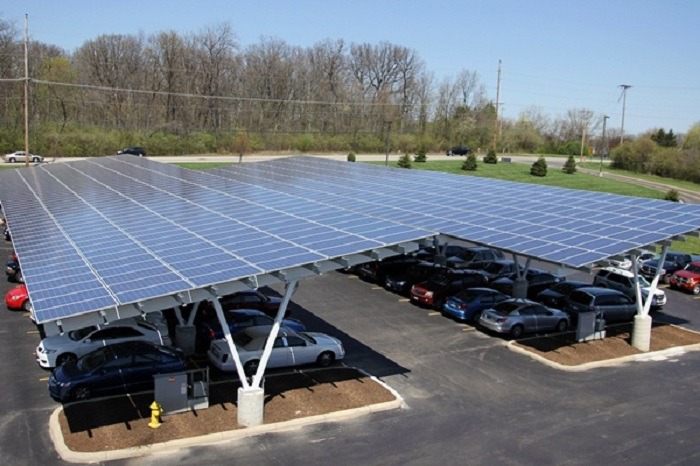
A recent viral video circulating across social media platforms has ignited widespread debate in Lagos after officials of the Lagos State Ministry of Housing were seen confronting a resident over the installation of solar panels on his apartment.
The footage, obtained by PulseNets, showed officials attached to the ministry’s Monitoring and Compliance Unit informing the resident that approval and payment of an administrative fee were required before the solar installation could proceed.
The incident immediately triggered outrage among many Lagos residents, with critics accusing the government of introducing additional financial burdens at a time when citizens are increasingly relying on alternative energy sources to cope with Nigeria’s persistent electricity challenges.
Responding to the controversy, the Lagos State Government clarified that permits and administrative charges relating to solar power installations are applicable only within government-owned social housing estates and not to private homeowners or tenants across the state.
Public reaction has remained divided. While many residents expressed frustration that authorities appeared to be targeting citizens who are independently providing electricity for themselves, others warned that such regulations could discourage investment in renewable energy solutions amid worsening power supply conditions.
Some critics further argued that the policy sends the wrong signal to residents already struggling with unreliable electricity, claiming it reflects an attempt to generate revenue rather than encourage energy independence.
Reacting via a post on X, Senior Special Assistant on Media to Lagos State Governor Babajide Sanwo-Olu, Wale Ajetunmobi maintained that the resident featured in the video misunderstood the existing policy framework.
“This development is true, but the man who made the video seems to be misinformed about the Lagos State Government’s guidelines for installing solar energy systems in social housing estates,” he said.
Ajetunmobi explained that administrative charges apply exclusively to occupants of government-owned social housing estates whenever structural modifications, including solar installations, are proposed.
According to him, the government acts as the facility manager for such estates and must oversee alterations that may impact shared spaces or affect the original architectural design of the buildings.
“Only residents living in government-owned social housing estates are charged administrative fees for alterations, such as the installation of a solar power system, before any additional development can be permitted,” he said.
“Any alteration must be processed through the physical planning and survey departments of the ministry of housing for approval, material compliance, and post-inspection checks.
“Those solar power systems are usually installed by occupants in shared areas; so this alteration must be approved by the facility manager (government) before any occupant can proceed.”
The governor’s aide further stated that the individual in the viral video was likely a tenant occupying one of the government-owned housing units through a property owner and may not fully understand the provisions contained in the indemnity agreement associated with the property.
PulseNets learned that officials seen in the footage were members of the ministry’s Monitoring and Compliance Unit, while the resident reportedly commenced installation without obtaining prior approval from the relevant authorities.
Ajetunmobi also noted that the government had previously dealt with liabilities arising from unauthorized modifications within its estates, including incidents involving roof damage and fire outbreaks.
“He is likely to be a tenant in one of these social housing estates owned by the Lagos state government, otherwise, he wouldn’t have raised concerns about something that was clearly outlined in the indemnity document he signed before the government handed over the apartment to him after purchase.
“The simple rule for any estate occupant is to contact the state government (facility manager) for approval for any external alteration.”
He further argued that unauthorized modifications affecting common property could expose the government to legal and financial liabilities involving other occupants within the estate.
Under the Lagos State Urban and Regional Planning and Development Law, structural modifications to buildings require approval from designated regulatory authorities.
However, what initially appeared to be a routine regulatory matter concerning solar panel installation within government housing estates has evolved into a broader public conversation about governance, taxation, housing policies, citizens’ welfare, and the limits of government oversight during a period of mounting economic pressure.
Beyond criticism of the regulation itself, many residents are now demanding that such provisions be abolished, describing them as the commercialization of survival in a society where citizens increasingly provide essential services for themselves.
For a significant number of Lagosians, the controversy extends far beyond renewable energy. Many see it as another example of growing bureaucratic hurdles, levies, permits, and approvals imposed on residents who already shoulder the responsibility of securing electricity, water, and security independently.
Some residents argue that while governments in many developed countries actively incentivize renewable energy adoption through subsidies and grants, residents in Lagos appear to be facing additional costs for embracing alternative energy solutions.
Despite the government’s clarification, public anger has continued to intensify, with many residents remaining skeptical of official assurances.
Several Lagosians insist the policy could represent the first phase of a broader framework that may eventually be extended to private estates and homeowners across the state. According to them, early opposition is necessary to prevent any future expansion of such regulations.
Another concern repeatedly raised is why citizens who already provide their own electricity, water supply, and security infrastructure should be required to pay government-related charges for harnessing energy derived from sunlight, a naturally available resource.
Speaking to PulseNets, a businessman residing in a private estate in the Amuwo Odofin area of Lagos, Anthony Osewele, strongly criticized the policy.
“The state government has no right to sell God’s energy.”
“When people decide to arrogate to themselves the position of God, you wonder if they still had any iota of conscience in them.
“Nobody has the right to sell solar energy provided by God. We are talking about solar energy that is from the Sun; God free gift to humanity. The sun is the centre of the universe. So, for me, it is evil and the height of wickedness for anybody in authority to even conceive the idea of collecting money from citizens for using sunlight. That means one day, they will find a way of collecting money from citizens for breathing the air. This is condemnable in every form.
“In other climes, we are talking about the government providing electricity to their citizens 24 hours nonstop. But here the government provides darkness, making life hellish and short for the people.
“And when the people move to provide alternatives just to improve their lives, the government is here to add to their sorrow by taxing them for doing that. This is very bad,” he stated.
Echoing similar concerns, lawyer Marcellus Onah told PulseNets that the growing adoption of solar power is not driven by luxury but by necessity, resulting from years of unstable electricity supply.
“People are buying solar because the government has failed to provide stable electricity, which is the minimum any responsible government should provide.
“We provide water for ourselves. We generate electricity for ourselves. We fix roads around us. Despite all these, the government still wants to charge us for trying to survive. It is very bad and unacceptable,” he stated.
Also Read: INTERPOL Arrests Lagos Businessman Ahmed Akanbi in Benin, Extradites Him to Nigeria Over Multiple Killings
An estate agent, Rowland Adebayo, also spoke to PulseNets, lamenting what he described as the increasing burden of multiple taxes and levies imposed on residents without corresponding improvements in public services.
“They have introduced road parking fees. They demand tenement rates. Every day, there is one new levy or another.
“I don’t mind paying taxes if the government is doing the right thing.
“But asking people to pay for installing solar energy is criminal. It is like taxing sunlight, which is a free gift from God and we must resist it,” he stated.