The Hypocrisy Around Jonathan by Sam Presto
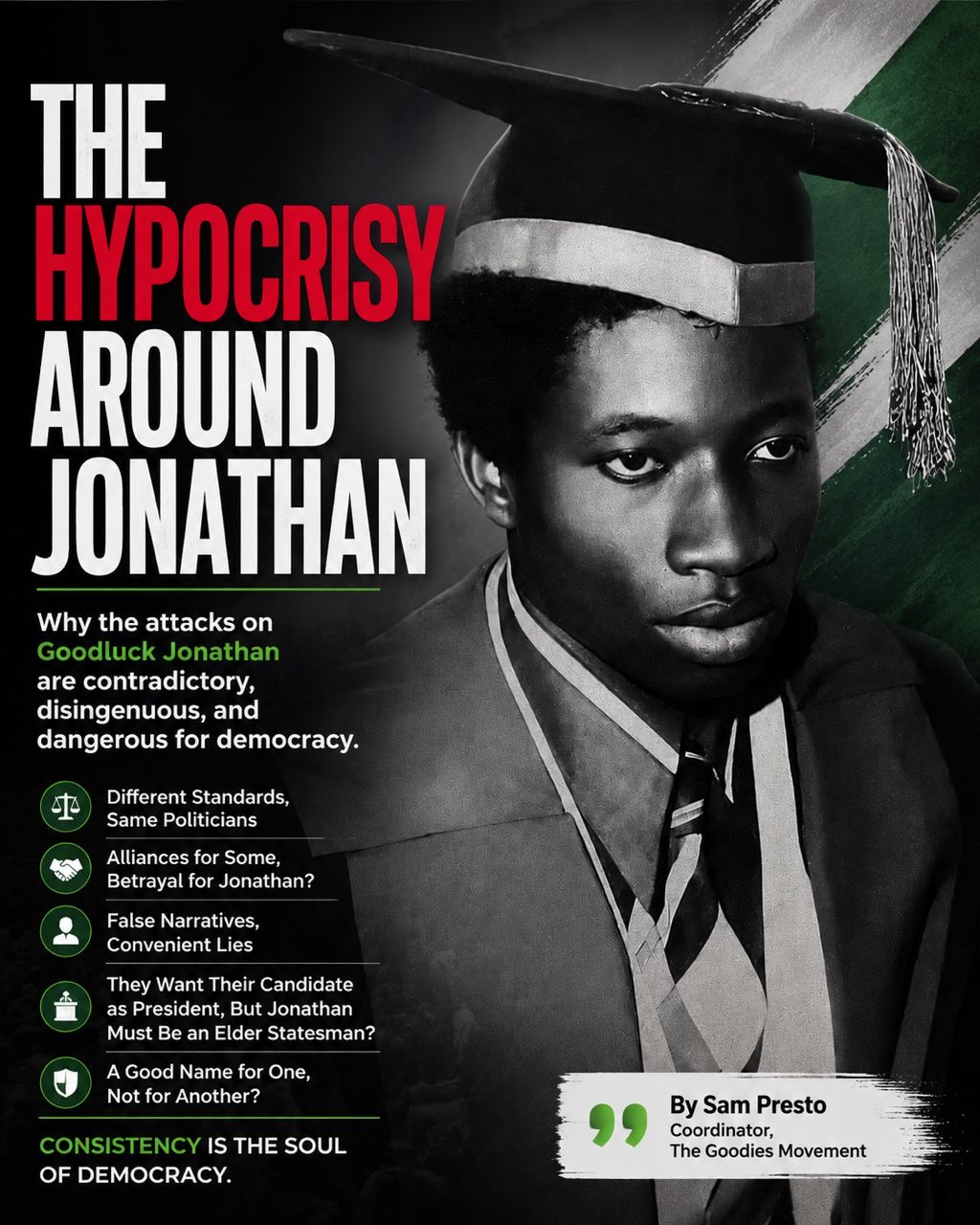
THE HYPOCRISY AROUND JONATHAN
An open letter recently addressed to former Nigerian President Goodluck Ebele Jonathan urged him not to contest the 2027 presidential election. While every citizen has the right to express an opinion, the arguments presented in that letter revealed what many observers may consider a troubling level of political hypocrisy.
The issue is not whether Dr. Jonathan should contest or not. The real issue is whether the standards being applied to him are the same standards being applied to other potential candidates.
The “Don’t Contest” Argument
One of the central arguments in the letter is that Dr. Jonathan should stay away from the 2027 race in order to preserve his legacy.
Yet many of those making this argument are simultaneously encouraging and promoting their own preferred candidates to contest the same election.
If contesting for president is a legitimate democratic right for one candidate, why should it suddenly become unacceptable for another candidate?
Democracy is built on choice. Nigerians should be allowed to decide who leads them through the ballot box, not through coordinated campaigns aimed at discouraging certain individuals from even entering the race.
The contradiction becomes even more obvious when one considers that Jonathan remains one of the few Nigerian political figures with significant national recognition across different regions, generations, and political divides. If political participation is a right, then that right must apply equally to everyone.
The Politics of Forgiveness and Alliances
Another claim made in the letter is that some of the same politicians who worked against Jonathan in 2015 are now supporting him.
Even if one accepts that claim as true, where exactly is the problem?
Politics is full of alliances, realignments, reconciliations, and changing interests. The same people who criticize Jonathan for allegedly working with former opponents often celebrate similar political negotiations when their own preferred candidates engage in them.
Many politicians today are actively reaching out to former rivals, former critics, and former opponents in pursuit of broader coalitions.
When others do it, it is called “strategic alliance.”
When Jonathan is accused of doing it, it suddenly becomes “betrayal.”
That is not consistency. That is hypocrisy.
More importantly, Jonathan has consistently projected himself as a politician who does not believe in personal vendettas. His public philosophy has always been centered on reconciliation, peace, and national unity rather than political warfare.
If forgiveness is a virtue, it should not become a crime simply because Jonathan practices it.
The Tinubu Narrative
Perhaps the most confusing allegation is the suggestion that Jonathan is somehow working for President Bola Ahmed Tinubu.
This narrative raises more questions than it answers.
The same political actors who accuse Jonathan of secretly serving Tinubu have often defended political negotiations and engagements involving their own allies whenever such discussions appeared politically beneficial.
Political dialogue is normal in every democracy.
What is not normal is creating one standard for your preferred politicians and another standard for those you perceive as rivals.
Jonathan’s political history does not support the idea of a man driven by personal bitterness or revenge. The leader who famously declared that his ambition was not worth the blood of any Nigerian is hardly the type of politician known for destructive political calculations.
The attempt to paint him as a willing tool of another politician appears less like a serious argument and more like a convenient political narrative.
Elder Statesman or President?
The letter argues that Nigeria needs Jonathan as an elder statesman rather than a presidential candidate.
This sounds noble on the surface, but it raises an important question.
Who possesses the greatest constitutional authority to influence governance and implement reforms?
The answer is simple: the President.
While elder statesmen can advise, recommend, and encourage, the power to execute policies rests with those elected into office.
Therefore, it is curious that some people insist Jonathan should remain an observer while actively campaigning for their own preferred candidate to become Commander-in-Chief.
If leadership experience is valuable, why should that experience automatically disqualify Jonathan but qualify someone else?
The logic simply does not add up.
The Legacy Argument
Perhaps the most contradictory argument of all is the claim that Jonathan’s reputation is too valuable to risk through another election.
The same people making this argument often support candidates precisely because they believe those candidates possess integrity, competence, and a positive public image.
If having a good name is a reason to avoid contesting, then many of the candidates they currently support should also withdraw from politics.
A good reputation should not be treated as a political disability.
On the contrary, democracy benefits when individuals with strong public credibility are willing to offer themselves for public service.
The voters—not commentators, activists, or political pressure groups—should decide whether such individuals deserve another opportunity.
The Real Issue
The real issue is not Jonathan.
The real issue is consistency.
Political actors cannot celebrate democracy while attempting to discourage certain candidates from participating in it.
They cannot praise alliances when their preferred candidates form them and condemn alliances when others do the same.
They cannot demand fairness while applying different standards to different politicians.
Most importantly, they cannot claim to support democratic competition while seeking to narrow the field before Nigerians even have the opportunity to make a choice.
Also Read: 2027: His Comeback Will Shake APC, Opposition Camps — ADC Reacts as PDP Clears Jonathan
If Dr. Goodluck Jonathan decides to contest in 2027, Nigerians should evaluate him based on his record, his vision, and his capacity to lead—not on narratives designed to discourage his participation before the race has even begun.
Democracy is strongest when citizens are free to choose.
And that freedom must apply to everyone equally.
Sam Presto
Coordinator, The Goodies Movement