Gov. Dauda Lawal Rejected N300m Ransom Demand, Told Kidnappers To Kill His Brothers
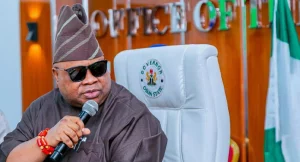
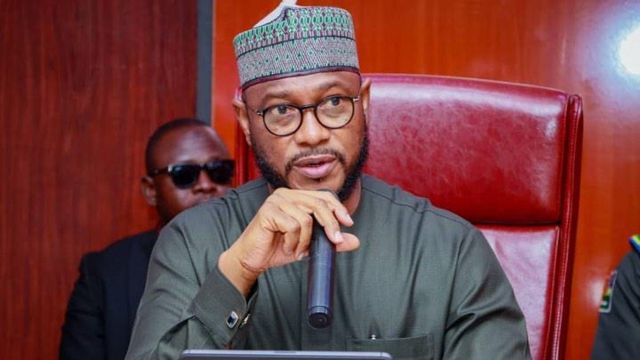
Governor Dauda Lawal of Zamfara State has disclosed that he refused to pay a N300 million ransom demanded by kidnappers who abducted his brothers in 2019, insisting that negotiating with criminals only fuels the growing wave of kidnapping for ransom across Nigeria.
The governor said his decision was driven by his conviction that paying ransom strengthens criminal gangs and encourages them to continue targeting innocent Nigerians.
Lawal made the disclosure on Thursday while speaking at the ARISE News and THISDAY Town Hall Conference in Abuja, where he also renewed his advocacy for the establishment of state police as part of efforts to address the country’s worsening security challenges.
Recounting the incident, the governor said the kidnappers demanded N300 million for the release of his brothers, but he declined to negotiate or make any payment.
“My own brothers were kidnapped in 2019, and these criminals were demanding at the time about 300 million. And I said, look, I’m not going to pay a dime. If you like, go and kill them.”
Lawal explained that despite refusing to pay, his brothers were eventually freed after spending about three months in captivity.
He said the experience reinforced his belief that paying ransom only empowers criminal networks and contributes to more kidnappings.
“By the time we continue to pay ransom to these people, we are encouraging them to kidnap people more and more.”
According to the governor, kidnappers would lose motivation if they realised victims’ families and governments would not reward them financially.
Lawal stressed that his position has remained consistent over the years.
“I will not negotiate, and I will not pay ransom to any criminal, no matter what happens.”
Lawal Renews Push for State Police
Speaking further, Lawal renewed his call for the creation of state police, arguing that governors should have operational authority over security within their states if they are expected to guarantee the safety of residents.
He lamented that although governors are widely regarded as chief security officers of their states, they lack constitutional control over the security agencies operating within their jurisdictions.
“Since I was called or I’m being called the chief security officer of the states, however, I don’t have the command and control structure to determine what happens or give instructions to some of these security officers.”
The governor noted that the existing arrangement leaves governors accountable for insecurity despite having no direct authority over the police and other security agencies.
Lawal described security as the bedrock of development, saying no meaningful progress can be achieved without protecting lives and property.
“Why is it difficult for people to understand that my primary responsibility is the protection of lives and property, and I don’t have that control? How do you hold me accountable?”
He argued that state police would strengthen accountability because citizens would be better positioned to assess the performance of their elected governors in maintaining law and order.
Lawal also maintained that state governments would be more capable of recruiting, training, equipping and funding security personnel based on their peculiar security challenges.
The governor further stated that the Nigeria Police Force continues to face challenges including inadequate funding, poor welfare and insufficient training, which have affected operational effectiveness and officer morale.
Zamfara’s Investment in Security
Highlighting his administration’s investment in security, Lawal said the Zamfara State Government currently finances more than 30 per cent of security operations across the state.
He disclosed that over the last three years, his administration had procured more than 500 operational vehicles for security agencies to strengthen the fight against banditry and violent crime.
The governor also revealed that the state recently acquired and handed over 35 Armoured Personnel Carriers (APCs) and Mine Resistant Ambush Protected (MRAP) vehicles to security agencies.
Lawal added that his administration has embraced technology by purchasing surveillance and combat drones.
“We bought drones, both surveillance drones and attack drones, to be able to aid the security forces in terms of fighting these criminals in their respective areas.”
He maintained that Nigeria’s security crisis can only be addressed through stronger institutions, improved funding, enhanced welfare, better training and modern technology rather than negotiating with armed groups or paying ransom.
His remarks come amid renewed national debate over the creation of state police, with supporters arguing that decentralised policing would improve intelligence gathering, accountability and rapid response to local security threats.
Governors, Senators Differ on State Police
PulseNets learnt that the debate featured several governors and senior government officials at the THISDAY/ARISE Television Town Hall Meeting on Building a National Consensus for State Police and National Security in Abuja.
Participants included Governors Chukwuma Soludo of Anambra, Peter Mbah of Enugu, Dapo Abiodun of Ogun, Dauda Lawal of Zamfara and Caleb Mutfwang of Plateau.
Other panellists included Deputy Speaker Benjamin Kalu, Minister of Defence Christopher Musa, Senate Leader Opeyemi Bamidele, Senators Adams Oshiomhole and Natasha Akpoti-Uduaghan, as well as former Chief of Defence Staff Lucky Irabor, among others.
Governor Dapo Abiodun argued that many states currently lack the financial capacity to sustain state police because of low Internally Generated Revenue (IGR) and federal allocations.
“But we all know that different states have different capacities to generate IGR. There is a discrepancy. I mean, look at a state like Ogun State now. It is the fastest-growing economy in this country by any standard.
“We are the industrial capital of this country by any measure. And yet, if you look at what we get from FAAC, we are probably among the bottom three.
“So these issues have to be addressed so that we can ensure that every state can adequately provide for its state police. We do not have a situation where one state has the capacity to do so and another state, of course, does not.
“Again, the issues that Senator Akpoti has raised are issues of governance and abuse.
“So we need to look at how to ensure that we have an independent Police Complaints Commission, even at the various state levels.
“I am aware that part of our discussions has included ensuring that we have the participation of not just the governors, but also the legislative heads, the Speakers of the Houses of Assembly, and the state Chief Judges, in the new Police Council that the President will be chairing.
“Also, the tenures of the police commissioners will be one term. That one term will ensure that a police commissioner has not become so domesticated and beholden to a particular governor to the point where he can be abused or used to abuse citizens, as she had alleged.
“So on that note, I believe that these sorts of town hall meetings and engagements are extremely important. I want to thank the Chairman of THISDAY and ARISE for organising them.”
Governor Caleb Mutfwang also backed the proposal but emphasised the need for sustainable funding and institutional development.
“What we are going to have is a consideration of three principles. One is a robust take-off. The second is state consolidation. Thirdly, we must also consider funding from a sustainability perspective.
“If we allow it to be subjected to the regular financing mechanism of institutions in Nigeria, then we are going to have a lot of fits and starts that will not be good for the system.
“You mentioned the issue of trust. It is when institutions do their jobs well that the citizenry will trust them. When they do not do it well, then there is a breach of confidence.
“We must do all we can. All hands must be on deck to ensure that we build a state police institution that guarantees the basic rights of the people, protects lives and property, and ensures that it is a citizens’ police and not a police for the elites and the leaders.”
Lawal, while acknowledging possible concerns over state policing, insisted that the benefits far outweigh the risks.
“For me, the advantages are more than the disadvantages. In terms of funding, I can tell you that I have funded more than 95 per cent of security operations in Zamfara State within the last three years. I have bought over 500 vehicles mainly for security purposes. That is just one aspect.
“About three months ago, the Minister of Defence was in Zamfara State to commission 35 APC vehicles that will be used to fight criminality.
“I am not going to negotiate with criminals. That has been my stand. I believe you cannot fight or negotiate from a position of weakness.
“I am not an expert, but from my little understanding, you can fight and negotiate from a position of strength, and I believe that we have the capacity to handle these criminals wherever they are. Yes, I am happy, and I fully support this process, which will now allow us to have state police.
“Concerning these abuses, we as leaders are elected to provide education, healthcare, infrastructure, and so many other things.
“So why is it difficult for people to understand that my primary responsibility is to protect lives and property, and yet I do not have that control?
“How will you hold me accountable? This is the reason we keep insisting that we need to be in charge. If we are in control, Nigerians have every reason to question us because security is fundamental, regardless of what the government wants to bring to society.
“If you are not secure, it is going to be impossible to bring any meaningful change. So I will not pay ransom to any criminal, no matter what happens.”
Soludo Calls for Broader Constitutional Reforms
PulseNets reported that Anambra State Governor Chukwuma Soludo, who joined the town hall virtually, threw his weight behind state police, arguing that the conversation should now focus on implementation rather than whether the system should exist.
He also advocated wider constitutional reforms, including fiscal federalism and judicial restructuring.
“I want to thank the National Assembly for advancing this constitutional amendment and also the President of Nigeria, whom I refer to as the Professor of Federalism. The issue of state police is in the context of a march towards a more functional and effective federal structure.”
“The issue is no longer whether or not to have state police. I think we have gone beyond that. The issue is how.”
Soludo said discussions should address operational standards, funding, arms procurement and judicial reforms to support a truly federal security architecture.
Senate Defends Legislative Process
Senate Leader Opeyemi Bamidele defended the constitutional amendment process, saying Nigerians had been actively involved through extensive public consultations over the past two and a half years.
“This actually started with the people. People were not left out of this. We have been on the issue of this constitutional amendment to establish state police for the past two and a half years.”
He explained that the National Assembly conducted public hearings across the country before considering the executive bill transmitted by President Bola Tinubu.
Also Read: Appeal Court sacks Zamfara governor, Dauda Lawal
Bamidele expressed optimism that the House of Representatives would adopt the Senate’s version to speed up the constitutional amendment process before transmission to state Houses of Assembly and eventually to the President for assent.
The discussion also featured contributions from Senators Adams Oshiomhole and Natasha Akpoti-Uduaghan, human rights lawyer Professor Chidi Odinkalu, and Defence Minister Christopher Musa, who all stressed the need for safeguards, sustainable funding and institutional reforms to ensure any future state police system operates effectively and protects citizens’ rights.